Thursday, August 02, 2007

education vs. experience

I'm convinced one of the reasons a long international trip is such a rare event for 20-something Americans is the lack of time in the socially acceptable life calendar.

I'm not talking about a few weeks or even a summer in Europe during college. One of the quickly apparent facts when you're staying in hostels in New Zealand or Australia or Asia is the relatively large numbers of English, Australians, Kiwis, Germans, Irish, Dutch, etc., who pack up and travel for months or years somewhere in the post-high school or post-college years.

It's common enough to have slang descriptions. In New Zealand, pretty much everyone was expected to have an OE, or overseas experience. Sometimes it came right after high school, delaying college for a few years. Sometimes it came during or after college. It seemed just as often it came in place of college. The Kiwis could go to Australia and work at anytime or go to the UK once with a two-year work visa. For your career, the choice to go live andbar tend in London was as valid as the choice to go to University, as long as you weren't planning on a specialized career. Or it was a chance to figure out just what you wanted to do before getting to school and being forced to choose a career plan. In England, the same idea is referred to as a Gap Year.

In the States, there is no term for it. There isn't even a concept. You leave high school, you go to college or get a job. You leave college, you better have a job. That, at least, is the general assumption present in most of the conversations about the future when you're in high school or college. When Kirsten and I were thinking about leaving and going to New Zealand for a year, the general consensus from everyone we told was they were envious, but it wasn't something they would even consider.

It also wasn't easy when we returned. I don't know how much having a year off on the resume affected either of us, but it definitely leads to some uncertainty when
you return with no job and no immediate prospects.

In New Zealand, a college degree wasn't as necessary to get into the general business world as it is here. It wasn't always a requirement. Life experience could also work, or even no experience at all; it seemed sometimes places handed out jobs hoping the applicant would figure it out on the job. Sometimes it works, sometimes it doesn't, but it's a concept hard to embrace with an American work background. Kind of like the standard three-week business vacation around Christmas. (I saw family-owned shops closed in early December, with signs in the door saying they were closed for the holidays and would re-open in mid-February.

It was one more aspect of a generally more relaxed society. New Zealand is nicely isolated from the go-go world of America and Europe businesses. The small population makes the country pretty much an afterthought for multi-national corporations, which probably contributes to the more relaxed business (and general) culture. Not
that I have a job at the moment to compare, but I'm not looking forward to getting back into the U.S. work mindset.

travel costs

I found some notes for blog entries I made while traveling which never got up here. The first one:

I'm not quite sure exactly how some of the people we met while traveling bankrolled their trips. I know people here weren't sure how we bankrolled ours (we worked in New Zealand, had some money saved, and used some credit cards). There were, I'm sure, people whose parents were paying for it. The English just saved up some money and then saw its value double or triple once they started exchanging pounds into other currencies. Other people had obviously laid out money for a round-the-world ticket and then squeaked by on odd jobs and low standards. We met a couple of people who had bought or inherited property they were renting, and using that income to travel.

One German guy we met in New Zealand had an even better system. He'd simply registered for classes. I didn't verify the details, but according to him Germany not only gave him free tuition, but also a living stipend and insurance as a student. So he simply wasn't showing up for his classes, since he happened to be about 11,000 miles away.

Monday, July 30, 2007

zoom


Once we got to Glacier, the weekend rushed by.

It seemed like all sensory input had a hard time making an imprint on my brain. It was hard to remember what people had told me five minutes later; it was hard to stop and take in the weekend. I tried to make time for all 100 friends and family, and in the end felt I didn't get enough time with any of them.
Staying up drinking until the wee hours of the morning Thursday night didn't help; certainly it made dealing with Friday morning tough. But mostly, the sensation was caused by the sheer amount of details and people to deal with. I didn't feel particularly stressed most of the time, but I did occasionally feel overloaded.

I probably didn't have to be. Most of the details were taken care of by others; our extended families took on several chores, and our friends pitched in with free labor whenever we asked. But since I had dealt with setting up much of the logistics and plans I felt I had to at least check on most of it (and Kirsten helped with some of the details I forgot to check on).

In the end there were no major crises, and everything went well. When it was all finished, I just realized I had very little grasp on individual memories of the event. I can pick them out if I try, but the overall impression on my memory is one big blur.

Two of my favorite quotes from the wedding came from friends who weren't even there.

A few days afterward, I checked me email and saw this message from Ryan regarding a blog post my brother Scott wrote:

I saw Scott's blog post, which was abbreviated in the RSS directory to "Today is my brother's wedding. It was a disa....", which I naturally extended to "disaster". I clicked on it with a beating heart, but as you probably know, the word was "disappointment". So I'm glad to hear that it was not disastrous, at least as far as Scott knows.

(And the disappointment was not in the quality of the wedding. It was because my brother couldn't be there, as the Peace Corps decided to send him to Jamaica with some poor timing.)

The other message came just a day ago, from a friend in my old haunt of Hattiesburg.

Welcome back to your life! Not having to plan a wedding anymore may be the biggest single relief in the world.


True that.

more photos, officially

For those of you who would like to see a selection of photos put online by our official wedding photographers, Stephen and Gavin, instructions are below.

You can find the photos at http://www.pictage.com/336470. The event key is:
070707Eklund

Enjoy.

Tuesday, July 24, 2007

signs

I'm battling to get into the jogging habit. (Sure, it might not be the best activity for me, but it's an activity, and it's one I think I can realistically do consistently. I'm still trying to find an Ultimate Frisbee or softball team to join, but until then, I've got to work with my brain and do what I can.) I had it for a while when I first got to D.C., then a number of trips (not least two weeks in Montana) broke any schedule I once had.

This week I've tried to start again. My first day I made the same mistake I always do when starting - run too fast at the start, nearly collapse from exhaustion five minutes in.
Yesterday, though, I managed to strike a more leisurely pace, one I could maintain for about 45 minutes. For more than another hour, I fought the urge to walk by forcing myself into a few short bouts of running. But after I lost my stamina, the afternoon mostly became about trying to walk the line between getting lost in a new part of town and keeping my bearing enough to return home. Part of me always hopes to get lost, just to figure out the challenge, but I also would just as soon be able to get back to the apartment within an hour of deciding it's time to head on back.

Most of my runs start in the finger of Rock Creek Park behind the apartment. It's easy to get lost in here; there's a number of named trails, but the signage is often lacking. It'll point you on your way, then the trail will pop out of the woods at a street intersection, with no indication of which way to go. It usually takes me at least a couple of tries to figure out where a trail goes once I decide to take it.

I've noticed a general problem with signs across D.C., at least outside of the National Mall area. Bus stops often list fares from at least two increases ago - if someone hadn't told me, I'd have had no idea I needed to get more change ready the first time a bus arrived. The road network to get out of downtown to Virginia is also less informative than I would like; until you've tried a route once, you have no idea just what lane you're required to be in to arrive where you want to go, or even where a particular road will end up.

But in the park, I mind the lack of information less galling. Getting lost is part of the attraction. Yesterday was no real exception - the signs lasted a bit longer than usual, but I still found myself taking random turns on sidewalks after the trail suddenly seemed to disappear.

I hadn't run west yet; I was pleased to find myself at the Potomac River and with the option of taking either one of a pair of trails I'd run into before, at a different spot. I've started to map out some longer routes in my head. Perhaps it'll come in handy if I ever get my bike fixed.

Stephen has put me to shame. Not only did he get a written account of the whole wedding up well before I did, but the writing was good, as well as the photos. I'm not sure I'll be able to compete.

So while I'm still composing my thoughts, go over to his blog post and check out the 29 photos he has up, along with a written account of his weekend as a wedding photog.

down on the farm

Before we actually headed up to Glacier National Park for the big event, we spent almost a week with my family on the farm where I grew up.

As usual for any family gathering, several aunts and uncles on my mom's side (who grew up on the farm) came out to spend time on the homestead as well. This time, there were some extra faces in the July 4 crowd. Some of Kirsten's family, as well as my best man and her maid of honor, came out a few days early to see the farm as well.

This worked out better than I had imagined - it was some of the only real time I felt I got to spend with anyone all weekend. It's sometimes a bit disconcerting to show friends aspects of your life that did not include them, but also always fun to see your childhood haunts through a different set of eyes.

(Although my childhood home has been going through an extended renovation ever since I left 10 years ago - brand new floors throughout, a re-roofing with expansion and a full deck have been added. I think my parents didn't know what to do with all their time once four kids left the house.)

We arrived at the farm one week before the wedding, Saturday night. On Sunday mom invited the town over for an open house/pre-wedding reception (a decent proportion of the town showed up - 30 people). Monday we drove up to Fort Benton for the blood test (Montana forced Kirsten to get tested for Rubella, for some reason). Tuesday the friends arrived, and Wednesday was a party for July 4. The afternoon was spent at my uncle's, 10 miles down the road. Kirsten's nephews and niece stole the show, running around trying to catch chickens and cows, petting the horse and demanding, and getting, a ride on the tractor (the much-anticipated highlight for any 5-year-old).

The crowd moved back to my parents' for the evening, capped off by the fireworks. July 4 fireworks always kick off fairly late back home, since the sun doesn't go down until almost 10 and darkness doesn't set in until closer to 11 in mid-summer. My best man, Tom, had taken the opportunity to load up on fireworks, as had my uncle, and all of them were shot off.

Before the fireworks, Kirsten's young relatives had taken it upon themselves to explore this new farm, as well (of course). The photo above is the oldest, Bradley, carrying stalks of wheat in our back yard.

Thursday, July 19, 2007

For those of you looking for a photo:


(Thanks to Steph for the pic).

Wednesday, July 18, 2007

wedding

As I was waking up the other day, my mind struggled to identify an odd weight on my finger. After a second, it clicked. The lump was my still-new wedding ring.

If I was writing a short story, this detail would serve as a metaphor for nagging doubt, or perhaps realization the marriage was dragging my life down from the heights of my dreams. Or something.

Thankfully, this isn't a short story. The weight isn't a metaphor, it's just an anecdote about my ring being too new for my mind to take for granted. The titanium ring is slightly raised and now prevents my pinkie from nestling up against my ring finger. My mind most often interprets this sensation as a swollen finger - to my pinkie, it feels like my ring finger has been injured and swelled to the point it has lost feeling. To my ring finger, my pinkie is insane. It's just a little bit of metal to haul around, most of the time unnoticeable. I'm sure before long my mind will become accustomed to the ring's presence and no longer bring nerves' signals regarding the ring to my attention.

For now, this marriage thing is new, but the ring is about the only evidence it happened. Well, the ring and the pile of newly-acquired kitchen products we need to find space for. Next month, I'll hopefully be covered under my new spouse's health insurance, which will make a big difference if I need it but none at all to my daily life.

As the wedding approached, many people asked if I was nervous. Generally there wasn't any nervousness, except on a few occasions when I wasn't sure some of the details for the reception would come off exactly right. But it was obvious the questions weren't about the ceremony or celebration itself.

The questions all had an undertone of "are you nervous about the whole idea of getting married?"

It is, of course, a valid question. Any major, irrevocable decision about life's path is bound to be accompanied by some nervousness. Especially if for you, like me, the phrase "growing up" sounds vaguely sinister rather than a goal to be embraced.

And there was some nervousness about the whole big-picture idea of getting married. For me, and, if she was telling me the truth, for Kirsten as well. It didn't happen as the ceremony approached, though.

For me, the real nervousness came not at the wedding, but rather at the proposal. That's when the natural and expected questions came to the fore: Is this really a good idea? What if it goes wrong? Does this mean I have to grow up and quit doing all those irresponsible things I do? (No.) That was a couple years ago. None of those doubts were seriously carried along to the wedding day. The big ones were dispelled over the past couple years, when, as Kirsten said, we've essentially been married anyway. Certainly while we were out of the country we were rarely apart, and we had to deal with the day-to-day details of living together and melding our different life visions together. Now, the only real difference the wedding made is I'm wearing a ring and I can get on her health insurance.

Monday, July 16, 2007

wedding advice

When we were looking into the details of our marriage in Montana we tried to find out who, exactly, could perform the ceremony.

Several people told us anyone could marry you in Montana. This was welcome news, since there wasn't anyone we knew in the area who fit in the traditional clergy/justice of the peace boxes and we didn't really want to hire someone just to do the ceremony.
We did have someone in mind - late in the evening after my brother's wedding, my uncle volunteered to officiate our wedding. I'm not sure he remembered his promise when we called him up several months ago to take him up on the offer, but he graciously accepted and did a wonderful job (complete with showing up to the day-before-the-wedding dinner dressed as a monk or jedi, depending on who you asked).

In the months leading up to the wedding, we realized Montana law did indeed limit who, exactly, could perform a wedding. I don't think my uncle falls into any of the categories, although I'm also fairly sure Montana wouldn't bother to check.

But rather than set us up for a possible headache, we found another provision in the law. Montana allows for a Declaration of Marriage without the need for a license or ceremony. Simply type up a statement which covers the specific details listed in the law, show up to a courthouse with two witnesses, pay the $53, and it's done. (Don't forget to get the blood test first).

I don't think many people take advantage of this option. Chouteau County officials said ours was the first Declaration of this kind they'd ever filed. They were happy enough to do it; they said it required less paperwork for them.


EDIT: I have been corrected. My uncle, is, indeed clergy. So we probably could have been fine under Montana's clause "in accordance with any mode of solemnization recognized by any religious denomination".

He says: The US Government is loath to judge the merits of various churches, so getting ordained through an ad in the back of a magazine is as legit as going to seminary in their eyes.

We were aware he'd gotten a back-of-a-magazine certificate. However, once we found the easy way out, we decided it wasn't worth it to check into how Montana determined if he was, indeed, acting in a manner recognized by "any religious denomination."

in D.C.

I'll get to the wedding posts in a minute, but I'll start by working backward. We arrived back in D.C. on Thursday night after nearly two weeks in Montana. Thankfully, D.C. was kind to us on the first day back. Humidity was at the low end, which made for a beautiful day (it wasn't until yesterday the soul-stifling mugginess returned, but at least we had a couple days to start the acclimation process).
Friday night we also took advantage of D.C.'s summer habit of free events. The National Symphony Orchestra was playing a free evening program outside in the Carter Barron Amphitheater in Rock Creek Park. Concert was good, although the accompanying cicadas were neither on time or in tune.
Saturday we had tickets to see The Decemberists accompanied by the Baltimore Symphony Orchestra. I've been playing the Decemberists nearly nonstop on my iPod for the last few months, so it was a show we'd been looking forward to. The symphony gave even more of an epic feel to their tragedy-story songs (which is most of them). A thoroughly enjoyable evening.
It was a much-needed ease into the return to reality after the break. Yesterday the ease was mostly gone; we spent the day in big-box suburban hell (Northern Virginia) to deal with a few wedding-gift exchanges and to use our new gift cards.

Now that the wedding is over, time to deal with the other two items on my list: figuring out how to maximize the space in our apartment and getting a job. Neither seems particularly enticing.

Saturday, July 14, 2007

we're back

The Internet rumors are true - I did indeed get married last weekend.

We're now back in DC, so I'll get some impressions from my two-week trip to Montana (and the wedding) up soon. For now, thanks to everyone who made the trek to Montana or who sent us well wishes.

Monday, July 02, 2007

it's a dry heat

We're in Montana, and the countdown has officially begun - wedding is on Saturday.

Most of the details have been planned, now it's just case of putting the plans into reality and making sure nothing fell through the cracks. People keep asking if I'm nervous - haven't really had a chance to think about it like that lately. All the details can get in the way of the big picture.

I'm mostly looking forward to seeing everybody. My family has started to arrive, and a few friends will show up on the farm before heading to Glacier. Thursday we head north to meet everyone else up at the Park and further stress about the details. Thankfully, we should have a day or two in the park afterward to decompress.

Also have to enjoy ourselves this week. The weather out here beats D.C. - it was close to 90 yesterday, but no humidity means the shade is cool. And it actually gets cooler once the sun goes down. Might hit 100 this weekend - stay out of the sun (especially if you happen to have a hangover, as I'm sure I won't at any point).

Thursday, June 28, 2007

what's-it's-name Park

I'm not necessarily opposed to all stadium naming deals. As long as the name isn't replacing a historically significant name and is on the stadium long enough to form a lasting recognition between the name of the stadium and the team which plays there, fair enough.

But there's a few problems with the current spate of brand-new ballparks with brand-new sponsor naming rights.

Stadiums in the first wave of the building boom have already moved on and changed from their initial name. I still think of the stadium in Houston as Enron Field, and I still refer to the Giants' park as PacBell.

The other problem is with so many new corporately-tagged stadiums, the names just blur together. I saw a game in Philadelphia just a couple weeks ago, and I had to look up the name of the stadium when I started to write this post.

The name (Citizen Bank Park) blurs away in my memory, and the park itself generally does the same. It has all the requisite new-retro styling. The concessions are varied and plentiful (and in a nice touch, a decent selection of microbrews are the same price as the big-name standards).

There are a few nice touches. The bullpens are both in centerfield, with the visitors' pen stacked a level above the home pen. When a visiting reliever is called into the game, he has to run down the stairs and past the Phillies bullpen staff to reach the field. Above the bullpens is a standing-room concourse, so fans can perch at the rails and look down at the pitchers warming up. It's like a balcony seat, with a pretty good view of the game as well.

There's also a few confusing touches. Television monitors are mounted above the back of the lower-level sections along the third-base line, so fans in the concourse or the further-back seats can see the action. There are no such monitors along the first-base side, even though the areas are otherwise symmetrical and I believe the price levels of the seats are the same.

I bought an upper-deck seat, but mostly stayed with the standing room crowd. I wandered the stadium, stopping to watch each inning behind the seats of a different section. (Ushers were stationed just about everywhere checking tickets, although I probably could have made it into a lower-level seat long before I actually did in the eighth inning).

The atmosphere reminded me of St. Louis. Same red-clad crowd, same general feeling of a baseball-savvy crowd. There was a surprising crowd of more than 42,000 for a Wednesday afternoon game. In a nice touch, the ushers prevented anyone moving from the concourse into their seating area during an at-bat.

The game was a good one, as well. Tied up late before the Phillies pushed past the White Sox for what was, in the end, an easy win.

Tuesday, June 26, 2007

details

I'm getting married in less than two weeks. It hit me today: in two weeks, I won't have to deal with any more details, any more getting ready for the wedding. After this, I won't have an endless to-do list to deal with. I might have some evenings free without the specter of details forgotten hanging in the air.

After this, all I'll have to worry about is finding work. Piece of cake.

heat


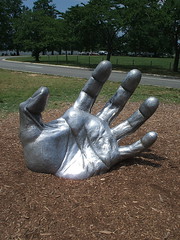
Hand

Originally uploaded by slack13

The past couple of weeks D.C.'s weather has officially gone from "pleasantly sunny" to "muggy as hell."
It hasn't been as abrupt as that - the first hints of the humidity showed at times, but the next day or so the air would clear and it would just be beautifully sunny, the type of weather that cries for you to go outside and revel in it.
The last couple of days, however, the weather has turned into the type that screams at you to stay inside, and turn on the AC while you're at it. I lasted until early June before even installing our window unit (although we did break down and buy a fan a week or so earlier). Today marks the first time I have needed, and I mean needed, to turn it on two days in a row.
When Kirsten first started to complain about the sultriness of the weather, I was able to laugh it off. After all, I'd just returned from New Orleans. Nothing here in early June could compare to New Orleans (and I don't think, even now, it's reached New Orleans-in-May levels). Now, however, the New Orleans trip has worn off. Even the four years in Mississippi and time spent in New Orleans never prepared me for the onslaught of stickiness summers below the Mason-Dixon line bring. A childhood of the dehydrated air of Montana ensures my body will never accept the continual oozing of sweat from the pores. It'll only be worse, much worse, in mid-July after having a two-week humidity-free vacation in Montana.


A few weekends ago, the weather was less humid and merely brain-meltingly hot. This happened to be the weekend my brother and sister-in-law were in town before leaving the country for a Peace Corps stint. The weekend they decided it would be a good idea to walk from my house to Georgetown, then down to the mall. I wasn't prepared for a three-mile walk with the 90+ degree sun beating down, and the concrete soaking it up and then spitting it back to bake us from below.


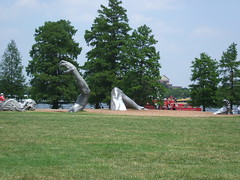
Awakening
Originally uploaded by slack13
The next day was a little better. We drove to Hain's Point, where we watched the planes take off from National Airport and clamored about on this big silver guy trying to claw his way up out of the ground.

Thursday, June 21, 2007

phone phun

Since moving into D.C. we've noticed an odd phenomenon - when we're talking on a cell phone at our house (where we don't get a real strong signal) and a plane flies over (which happens often, since we're under the flight path to Reagan National) our service momentarily cuts out.
I don't know why a plane overhead would affect signals from the ground-based cell towers. Our only (tongue-in-cheek) theory is the CIA is jamming cell signals underneath planes over DC.

Anybody else got an explanation?

Wednesday, June 20, 2007

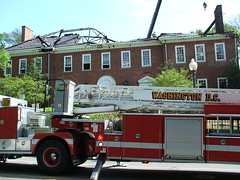
Fire


The day after
Originally uploaded by slack13
Here's a post I just never got around to writing-

Two days after my arrival in D.C. (April 30) a pair of local landmarks burned. The one which caught most of the city's attention was in the Eastern Market. On the same day, the Georgetown Library, just down the street from my house, also caught fire.
I've still never been to the Eastern Market (the merchants are still up and running, although in temporary locations while the building is being repaired). I've never been into the Georgetown Library, either, but I'd certainly planned to. Now I don't know what the closest library to my house is, but it's not within easy walking distance.
I'm not sure if the spate of fires in interesting buildings upon my D.C. arrival bodes poorly for my future in the city.

Tuesday, June 19, 2007

back in Thailand


Memories of Thailand came flooding back Saturday night. The reminiscing wasn't prompted by a travel discussion, a photo or a similar landscape. The memories were prompted by a bar.
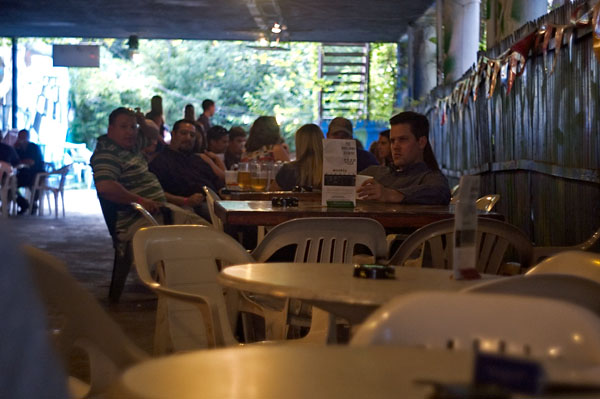
Specifically, Dr Dremo's in Arlington. The lower level of the bar is a dive (although the crowd turns it into a trendy dive) built in the style of Southeast Asia.
I'm sure this isn't on purpose. But the wall-less, roofed area on a concrete slab sets the scene just right. The colored lights and crazy-quilt decorating scheme continues the trend. And the plastic patio-furniture tables and chairs set up on the concrete, sitting in the humid air under weakly turning ceiling fans, perfectly captured the ambiance of just about every Southeast Asia bar, or restaurant, we entered.
Of course, the details shattered the illusion. There was a wide variety of beer, and it all cost considerably more than 80 cents a bottle. It didn't even come in the preferred Asian 600ml bottle, but in plastic keg cups. And once we walked upstairs, the bar transformed into a multi-level pool hall.


Image from Flickr user Furcafe

Tuesday, June 12, 2007

Saw my first urban deer today, driving into downtown. The doe was just hanging out in a well-upscale yard, grazing away just a few blocks from the park. A bit out of place, but a nice addition to the neighborhood all the same.

Turner Field

Part two in what could be an ongoing series:

For my trip to Atlanta, one of my friends picked up a few tickets to see the Braves take on the Mets. Turner Field made a good first impression - the tickets for the upper deck were on Tuesday two-for-one special, which put them at $4 a seat.

The upper deck seats also pleasantly surprised - although we were only a dozen or so rows below the top of the stadium above third base, the view was decent. We could see the whole field, and the stadium was built up enough it felt like we were looking down on the field, rather than out at it. It's enough of a distinction. I've sat in stadiums where the upper decks were pushed away from the field, and you felt like you were separated from the experience. Turner avoided that problem (although it still doesn't compare to Tiger Stadium, my gold standard for close-to-the-action upper deck seats).

The game was decent - an easy Braves win, but the lead was built up inning by inning, to keep people interested.
It wasn't a perfect day to watch a game - smoke in the air from Southern wildfires made my throat feel like I'd been swallowing sandpaper by the end. The overall experience at Turner, however, was pleasant.
The stadium is, like all the other stadiums built in the last 15 years or so, built on the Camden Yards neo-retro model. Lots of brick and green-painted steel. All nice, but there is only one feature of the ballpark that truely stands out and captures your attention. The center-field video screen scoreboard presented a sight to behold.
Apparently the high-definition screen was the largest in the world when it was installed, or at least is one of the largest you're going to find. The picture is about 80 feet tall and 80 feet wide, and unlike old-school video screens, the picture jumps out at you no matter what viewing angle you're at. (Well, I didn't sit directly in front of it, so I can't vouch for the close-up, directly-underneath view).
The big screen was complemented by something I've noticed elsewhere - in the two years I was out of the country most stadiums seem to have replaced the runs/hits/errors lighted scoreboards that used to sit somewhere on a narrow front of the upper seating decks with similarly narrow video screens. The screens show the scoreboard info during the action, and advertising or promotional info between innings.
The gadget-geek in me loves the high-def screens and video boards. The baseball purist in me isn't sure what to think - the old light boards weren't particularly aestheticly pleasing. As long as Fenway doesn't replace it's hand-operated board (and at least a few of the new parks keep their hand-operated out-of-town scoreboards as an homage) I can't think of a reason to decry the change.

Tuesday, June 05, 2007

Here is a wonderful essay on the character of New Orleans from a New Yorker writer who is writing a book on the city post-Katrina. Essentially, he talks about how the tyranny of time prevalent in most American's lives has far less of a hold in NOLA. It's certainly worth taking the time to look through the archives of the rest of the blog.

The essay reminded me of an observation I'd been struck by after we'd spent some time in the cities of Southeast Asia. New Orleans is often described as the "most European" of the U.S.A.'s cities, because of its unique character and French and Spanish influences, especially in the pedestrian-friendly (also a phrase you can't use very often in the States) French Quarter.
To me, however, the description doesn't quite fit. New Orleans, for better and for worse, is the closest thing the States has to a third-world city. The decay-inducing intense humidity, the cracked streets, the political system - these would be some of the "for worse." The easy-going lifestyle, the very loose adherence to time and appointments, the day-to-day absurdities which force you to laugh and loosen your own interpretation of what needs to happen - these I would include in the "for better."

Monday, June 04, 2007

FEMA trailers


FEMA trailer
Originally uploaded by w0bbly
A point I feel needs to be made:

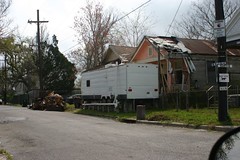
The phrase "FEMA trailer," heard often on the post-Katrina news about New Orleans and Mississippi, conjured up an image in my head of the mobile-home type of trailer. The type which takes -wide as an adjective: single-wide, double-wide, triple-wide. The trailer of the trailer parks I know and make fun of.

No. The unfortunates who live in the FEMA trailers as a home of last resort have a trailer, a vehicular appendage which can actually be towed down the road.
It's a shocking sight to see streets lined with a FEMA trailer in every front yard. To see the lengths of PVC pipe on the outside forming a semi-permanent plumbing system, and to know in some cases this will be semi-permanent housing. Many of these trailers have been called home for more than a year and a half, and in what I assume is a weighty proportion of cases, the residents will have little option but to call them home for the foreseeable future.
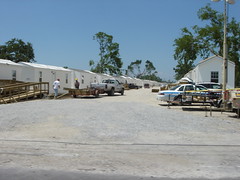
At least when you see the FEMA trailers parked in the front yard of a flood-damaged house you know the residents have a chance of moving out of the front lawn and into the house at some point. Far more depressing are the FEMA trailer parks. Rows upon rows of the trailers parked on lots of white gravel, fenced in by green-mesh-covered chain link.

FEMA
Originally uploaded by yellowjacket186
One day I watched a couple kids run along the row of gravel between the trailers and realized they probably have no home to hope to move into. Perhaps their house was washed away. Perhaps they were renting, and the post-Katrina housing crunch has priced them out of the market. Either way, they are likely to spend a lot more of their childhood playing on gravel and sleeping in a mid-level RV.

Wednesday, May 30, 2007

happy birthday to me...

Gumbo at Liuzza's.
Dinner at Jacque-Imo's.
Rebirth at the Maple Leaf.

All good.

Tuesday, May 29, 2007

NOLA

I've spent a fair bit of time in New Orleans. I lived in the city for one glorious, liver-damaging summer. My post-college job was 100 miles north, and I made sure to spend as much time down in the city as I could. I spent most of my time in the French Quarter-to-Uptown crescent of the city, the oldest part of New Orleans and the closest to the Mississippi river. This is, of course, the part where all the tourist highlights are, but it also incorporates plenty of local neighborhoods and authentic New Orleans character.
I tried to get out and see the rest of the city, as well. Driving the streets, taking random turns, seeing the areas I never had reason to visit. There are few cities as easy to get lost in as New Orleans; the streets have no 90-degree angles or grid pattern. When I lived here, I had experiences of trying to simply go around a block and ending up in the city's suburbs before I could re-orient myself. This is maddening when you are trying to find something in particular, but a quite agreeable trait when you want to soak up the city.
Before Monday, however, I'm fairly certain I'd never wandered into the Lower Ninth Ward of New Orleans. The area gained national infamy during the Katrina coverage as one of the hardest-hit areas after the levee breaks.
Before heading to the Ninth Ward, I'd gotten a feel for just how raw the Katrina damage, how much the devastation must continue to affect daily life for so many people. On the train ride in, driving around town, I saw the rows of houses boarded up, gutted, abandoned. I saw residential blocks with rows of FEMA trailers in every front yard.


Ninth Ward, New Orleans
Originally uploaded by Harrison414
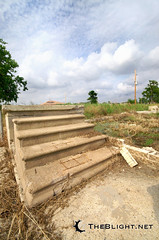
But nothing I saw compared to the sheer devastation present in the Lower Ninth above Claiborne. Nearly two years after the disaster, much of the debris has been picked up. Streets are not lined with houses, not even damaged houses. Streets are lined with weeds, through which you can grab glimpses of concrete foundations, steps which once led to now-missing houses. Blocks might have one, or two, or three house shells remaining, serving to accentuate the missing. This was once a residential community. A community with problems, with poverty, but a community with people and with homes. Now it's a ghost.

Much of my old New Orleans is up and running. The old and relatively high-lying areas around the river - the French Quarter, Downtown, the Garden District, Uptown, Magazine Street - look much as they did before the storm. The Superdome and Convention Center leave no clue of the horrible days the displaced endured there. There are signs of the storm - every other building on Canal Street remains boarded up, as do many elsewhere. A tourist in town for a few days, especially one in town for the first time, could leave with the impression New Orleans has put Katrina behind.

In a way, it's a shame so much of the damage occured so far from the New Orleans the rest of the country knows. The tragedy New Orleans endured and is enduring, has, I think, faded from the national consciousness. Outside, Katrina was a tragedy, was a horrible thing.
Inside New Orleans, you can tell, it still is.


Originally uploaded by mr_nightshade

One of the few things about the States I missed in my time overseas was a good cheeseburger. Thanks probably to the global fast-food chains, hamburgers are on the cheap-eats menu everywhere, at least in the English-speaking world, but perhaps also because of the global fast-food chains, something gets lost in the translation.
I ate plenty of burgers in New Zealand and Australia, and not one left me satisfied. There was a variety of reasons, usually starting with the meat - it seemed the ground beef was more often than not cut with with soy protein or some such thing to bulk it up. Even if the meat was right, there was always something off, such as the sweet-rather-than-salty ketchup Down Under. Apparently the just-right combination of a ground beef patty with cheese melted into its very essence topped with a lightly grilled or toasted bun and accesorized with some mix of toppings, just isn't one easily hit on outside the States.
(I did find one great burger during the 15 months we spent overseas. It was in north Thailand, of all places, at a little burger counter opened by an American Vietnam vet.)

I've had a chance to catch up on my burger shortage. In Atlanta I nearly had an overdose. The "Coronary Bypass" at the Vortex wasn't even close to the biggest or best burger I ate last week.

The Ghetto Burger at Ann's Snack Bar is not only the largest single object of ground beef I have ever eaten. It's more than a burger, it's an experience.
For one thing, you can't just waltz up and expect to grab a burger. Ann, who has been running the Snack Bar for about 35 years, serves the people sitting at the nine stools inside. If you get there when the stools are full, as I'm sure they always are, you wait until there's a space. We arrived at 3 p.m. There were about eight people ahead of us waiting to get inside. We finally made it to one of the coveted stools around 4:15.
(As the lady waiting next to us said when a couple bailed after waiting about 15 minutes: "You got to want it.")
Once we took our seats, it was another 45-minute wait for the burgers. This wasn't due to lack of service, it was because the burgers were made to with care. Patties at least two inches thick covered the entire grill. Onions were grilled, buns were toasted, bacon was deep-fried (I knew I would love the finished product as soon as I saw the raw bacon loaded into a fry basket).
When we finally were handed our Ghetto Burgers, we had in front of us a double-cheeseburger (each two-inch think patty must have weighed at least three-quarters of a pound) topped with bacon, onion, lettuce and, wonderfully, chili.

I finished the burger. My body complained for the rest of the day. It was totally worth it.

(And I'm not the only one who thinks so.)

Monday, May 28, 2007

the dirty south

My week in Atlanta was mostly a culinary tour of the city. I was more interested in hanging out with friends that I hadn't seen since well before I left the country, so I didn't feel a need to hit up all the tourist sites.
I did do a fair bit of driving around the city, though, and I was struck by the very different character of different spots in the city.
Here's how Atlanta appeared to me: islands of new, wealthy, trendy or commercial areas surrounded by seas either of wooded residential neighborhoods or the grit of the poorer, urban, mostly black Atlanta.
Don't get me wrong, I enjoyed Atlanta. The stories about its rapid growth over the last decade or so rang true - it seemed much of the city was either under construction or had obviously been built recently. The interstates were strained by the traffic load even at 2 p.m. It is spread, or sprawled, out but this also seems to lead to several different neighborhood areas carving out their own identity.
Riding around Atlanta I found it difficult to keep my bearings; every trip from one area of the city to another seemed to require driving through winding, wooded streets before popping out at whichever business district we were looking for.
Downtown is a big more straight-forward, but once you get out of the high-rise corridor, you run across the gritty underbelly of the South's population hub.


I didn't completely miss out on Atlanta's sights - we spent time at the High Museum of Art, caught a baseball game at Turner Field and walked along the street where Martin Luther King, Jr. was born, now a National Historic Site. The houses on the block are generally well-kept and newly painted, although even here the processes which have led to the blight of the inner city and explosive growth of the suburbs are at work; the house next door to MLK's childhood home is abandoned.

Tuesday, May 22, 2007

I've been in Atlanta two and a half days, and my only impressions of the city so far is this: the food seems designed to kill rather than nourish.
Today I ordered a meal that was listed on the receipt thusly: "1 coronary bypass, med."

And today was actually a detox day. After meeting up with friends in D.C. Friday night and lots more friends here in Atlanta Saturday night, being behind on sleep and going out for a while again last night, a detox day was needed. Mostly, I think more sleep is needed.

Tomorrow, I'll venture into the city rather than just the bars and apartments of friends. At least that's the plan.

Thursday, May 17, 2007

There are lots of things about New Zealand I took for granted while I was living there and had forgotten about. Living in the States again has highlighted some of the little differences again, such as the Kiwi practice of everyone always thanking the bus driver when they get off a city bus.
Riding around in D.C., I just can't imagine anyone doing such a thing. I'm also not sure what the response would be; probably suspicion on the more local bus lines. Today I did see bus drivers patiently helping out tourists, which I wasn't expecting. Some of the grateful tourists thanked the driver, but those don't count in terms of the point I'm trying to make here.
I guess the point is, I'm far more rude here to my bus drivers when I leave their bus, at least if total indifference on both our parts is judged as rude.

An uncle visiting New Zealand reminded me of the country's native Moa, one of the largest birds of all time but which is now extinct.

However, Te Papa, the National Museum of New Zealand, has recreated what they think the Moa's call sounded like, based on the size of its neck and vocal cords and other factors.

Hear the Moa here.

Wednesday, May 16, 2007

ferry fun


As the porthole exploded inward and I was drenched with a couple gallons of sea water, shipwreck movies were running through my head. When the ocean starts to crack the windows and flood the ship, it's time for the characters to panic. A few of my fellow passengers were eager enough to pick up the cue.
About all I could do was sit there, muscles tensed, clutching the armrests of my seat and watching as a skinny Thai crew member was nearly bucked off the bow of the ship as he lashed a sheet of metal over the hole where a window used to be.
On our way in to Koh Pha-Ngan the ferry ride was no sweat; it was a relief after an overnight bus ride from Bangkok. After a couple of nights partying and days doing exactly nothing on the island, it was time to head back to Bangkok and finish our time in Southeast Asia.
The morning weather on the island was fine. I didn't notice the rough seas until we got on the boat - a modern catamaran accommodating more than a hundred people. The route was in two hour-long steps: Koh Pha-Ngan to Koh Tao, another island off the Southeastern Thailand coast, then on to the mainland.
As soon as we left Koh Pha-Ngan, the boat was rocking in five-to-10-foot swells. Just big enough to throw me into my first bout with seasickness. I managed to avoid any personal food expulsion, but when we pulled into Koh Tao I was fighting nausea. During a layover on Koh Tao I popped a seasickness pill (a great decision) and my stomach decided it didn't need to scream at me anymore and settled into a sulking grumble.
By this time the sky had turned gray and a few short downpours had all the passengers huddled with their luggage in the snack bar or under the waiting area's roof. The scheduled layover dragged on, and word spread the boat from the mainland - which would take us to shore - was running late.

Eventually we loaded up. The rain forced the crew to move all luggage inside the passenger compartment, rather than the normal practice of piling it on the front deck. As the ferry pulled away from the dock, it became apparent the wait had only intensified the waves. The swells now were 10-15 feet, and every time the boat rose up on a wave, it violently slammed down into the water on the other side. It felt like we were constantly being picked up and dropped a few feet onto a parking lot. The boat shuddered on every landing, then made another rapid ascent up the next wave. In the brief instant of weightlessness at each peak, my stomach kept going up even as the rest of my body started to drop with the boat. Each parabola of rise and fall also propelled me up off my seat, and then back down, unless I physically held myself tight to the chair.
Eventually, the impacts took their toll - the plastic casing around some florescent lights at the front of the cabin came loose, crashing into a group of already-nervous passengers. One girl in particular ended up with more of her blood outside her leg than she would have preferred. Just as the crew had gotten her panic attack under control and moved her to the rear rows of the cabin, a far more alarming wave hit.
Instead of hitting this wave head-on, the boat was at a bit of an angle. The front right corner led as the boat tilted down into a trough, and the boat was stilled dipped when the wave crashed over the corner of the deck and up into the front of the boat with enough force to blow out a window. That's when I became soaked with saltwater and starting thinking about shipwreck movies, as well as the two-paragraph stories on ferry sinkings in developing countries; the deaths always well outnumber the survivors, by about 100 to 1.
The people across the aisle from me had pieces of glass coating them, along with sea water. Those passengers who weren't simply stunned by the event voiced some concern.

"We're going to die!"
Comforting to all, of course.
"We must go back!"
This one gained some traction among the group; we were only about 15 minutes into the trip and could still see the dock behind us. The Thai crew did their best to talk everyone down, although most people shouting were more interesting in voicing their opinion than listening to anyone else. A few individuals defused the crowd by pointing out the captain was likely better qualified than the screaming passengers to make such a decision. The captain, above in his cabin and unseen by the passengers, did make one concession to the situation by slowing down considerably. With a bit less momentum, the boat avoided any more waves breaking into the boat. The crew passed out doses of menthol oil which served two purposes: for one, it was calming and seemed to combat both seasickness and the low-level anxiousness which the roiling sea induced.
It also masked the scent of the passengers whose seasickness got the better of them; once one or two passengers' stomachs sent their contents outward, the urge was contagious. It also wasn't helped by the seasickness bags the crew passed out, which happened to be clear plastic.
The hour-long trip instead took more like two and a half. The surreal sense of the whole trip was only heightened by the TV monitors playing "Deuce Bigalow: European Gigolo" in the corners of the cabin. Although I suppose it was better than "Titanic," or "Poseidon."


There is a postscript to this story. Our journey from the islands to Bangkok was supposed to take about 12 hours, putting us in Bangkok around 11 p.m. that night. Instead, the tropical depression off the coast delayed and slowed our ferry, which meant we missed our bus connection. We ended up arriving in Bangkok at about 4 a.m. We had no room reservation (a concept that doesn't exist in Asian backpacker budget accommodation). We walked along the backpacker area and found a room available for about 800 baht, or $20. Instead of taking it, we searched for another 45 minutes until we found a room for about 500 baht, or $12.50. A month in SE Asia will seriously screw with your cost-comparison calculations. We seriously felt the first room was simply too expensive to even consider, even though we were exhausted and it was 4 in the morning. Instead, we sacrificed an hour of sleep - when we knew we'd have to check out of either place in the morning - to save about eight bucks.
It didn't even strike us as unusual at the time. In a month traveling around Thailand, Laos and Cambodia we probably paid an average of $7-8 a night for accommodation, and that's double beds and private rooms, not the dorm beds we paid $20/night each in Australia. In SE Asia, most restaurants posted their menu (in English) outside. After a week or so, we'd look at the menus, and if any one item cost more than the equivalent of $2.50 or so, the place was too expensive and we'd find somewhere else.
Then, in Iceland, we stayed at the Salvation Army, in dorm beds, in separate rooms, and paid the equivalent of about $40/night each for the privilege. If we wanted blankets, it was an extra $7/night.

One year ago...

...I was complaining about the lack of central heating in New Zealand.

And we were preparing to leave Wellington for the final time. Doesn't seem like it's been anywhere near a year. We went driving around the city, exploring a few corners we hadn't seen in our months living in the city, and checking out a little-used viewing area of the city.

Downtown Wellington from Tinakori Hill


I still have a ton of stuff from our trip I've been meaning to get up here. I realize I need to do it quickly, or it's going to lose even more relevance. At this point, it's more to help out my own memory. So hopefully I'll put up a few travel dispatches from places I didn't get to blog about at the time.

I'm also going to be taking a shorter trip soon - this weekend I'm flying to Atlanta to see some friends there and in New Orleans/Southern Mississippi. Back in D.C. in June, then have to seriously start worrying about getting a job (and our upcoming wedding).

Tuesday, May 15, 2007

i love living in a city, but...

Last night we ended up out late. When we got home, it took me literally an hour to find a spot to park the car.
Even better, our temporary parking permit expired yesterday. While we wait for our new license plates and registration to arrive from Montana (so we can get a longer-term temporary permit) I'll be moving the car every two hours today to comply with our neighborhood's parking regulations.

Sunday, May 13, 2007

(narrow) roads of the world

During the year in New Zealand many differences between there and here faded from my notice as "there" became "home," at least temporarily. But I never stopped marveling at the difference in the open roads. Even the major roads in New Zealand can turn into narrow, winding mountain roads. And the road is liable to turn into a single lane anytime there's a bridge of any kind, even if the bridge in question is just a few feet long and crossing a stream. At least the NZ road authority is nice enough to put up signs warning you of every one-lane bridge, and telling you exactly who has the right of way when you and another car arrive at opposite ends at the same time.


And there is, as you can see, at least one bridge in the country that with a single lane caters to two-way automobile traffic as well as the occasional train. (Trains always have the right of way).

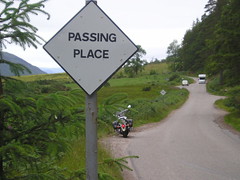
Then we left New Zealand, and found the roads progressively get narrower. From New Zealand's one-lane bridges, we went to Scotland's one-and-half lane roads.


The Scots do provide plenty of passing places, or spots just long enough for a car and just wide enough for two cars. In some lengths of road, there are so many passing places one side of the road appears to trace a sine wave.

Nevertheless, Ireland tops them all. The Irish just pave a lane one car wide, put stone walls on each side with no shoulder or margin of any kind, and then just throw them open to traffic in both directions. There were places I was afraid I was going to scrape both sides of my car on the rows of stacked stone, and that was before I met someone coming the other direction. I got lucky in Ireland; unlike some New Zealand trips, on the Emerald Isle I never had to back down a road after meeting another vehicle in order to reach an area wide enough for the both of us.


The entire time I was driving the Conor Pass part of my brain was filled with curiosity about what, exactly, would happen if we met another car. Another part was dreading an encounter. Most of my brain, however, was occupied with trying to keep the car on the narrow road as we wound up the hills in a dense fog.
Ireland's highest mountain pass might not stack up with the high-altitude drives of the Rockies. But the Irish certainly put a decent degree of difficulty on the whole thing.

Tuesday, May 08, 2007

a secure, undisclosed location

I now live about 1/2 mile from Dick Cheney. Not that you'd know it without doing some research. The house of the No. 2 executive is harder to get close to than his boss' house.
The grounds of the US Naval Observatory, where the Vice President residence is located, is completely fenced off and all entry points are guarded. That's not so surprising. The fact you can barely catch a glimpse of the house from the street isn't surprising. This being DC, the fact there is no sign or other acknowledgement it is theVP's residence is a bit surprising.

The real surprising thing is that you can't even see the place online. At least not with Google maps or Google Earth. Yahoo! maps still has the area in high resolution, at least last time I checked.

back in the day


Old Baylor Park-6
Originally uploaded by jmtimages.
In contrast to the previous post...

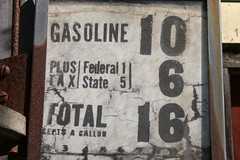
(The lowest I remember is filling up for 79.9 cents a gallon in St. Louis in college - sometime around 1998).

i'm glad I live on a bus line...


DC Gas prices
Originally uploaded by Focused.
In abstract theory terms, I don't necessarily think higher gas prices are a bad thing (although it'd be nice if there was some sort of infrastructure to allow more people to get by without using gas first).
However, it's a little bit of a shock to see prices jump 15 cents in a week. When I got here, I filled up in DC for $2.959/gallon, a price that was a few cents lower than most stations in the area. Today, I put in a few gallons at $3.099 per, a price I was happy to see - it was at least 10 cents below anything else I saw. (And I actually found that price in Maryland).

Friday, May 04, 2007

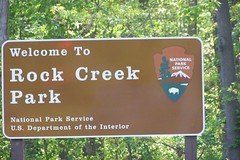
Rock Creek Park


Rock Creek Park
Originally uploaded by Mad African/Appler!.
It's also a little fun to walk out of your house onto a city park trail, and see that it's technically a National Park. Where all the neighbors are walking their dogs.

what i've learned today

When you're fat and out of shape, here's a tip if you'd like to run for more than five minutes at a time.

Start Slower.

Thursday, May 03, 2007

the rest of the tour


So below you can see one shot of my street - here's a few more.
We're a few blocks off the businesses of Wisconsin Ave, and a few one-way and dead-end streets set the area off from the traffic. In the photo there's actually available parking, which isn't the case once the sun goes down. And I'm not looking forward to the headache coming up as we try to get a permanent parking pass.

The basement we're inhabiting isn't quite big enough for all our stuff - most of which has been packed up since we left the country in late '05. At the time, we thought we cut down all our possessions. Now I don't know where we'll put it all, especially since our closet is about a foot wide. I did get the important stuff worked out - the computer, TV and stereo are all hooked together after a run to Radio Shack for $25 worth of cables. So my clothes are all over the place, but I can download, watch and listen all through electronic entertainment bundle.

Our basement falls in the middle of a block of row houses, which I'm sure look nicer now than they will in November.

On the other side, where the entry/exit point to our humble basement actually leads, is the alley, and on the other side Whitehaven Park, part of Rock Creek park, which takes up most of North-central DC.

Today I made up my mind to go running for an hour in the park. I made it about 5 minutes. I was actually out moving in the park for an hour, but I only managed to run about a quarter of the time. Bad showing. Since I've got no real employment to worry about, I guess I'll have to work at that.


Tuesday, May 01, 2007

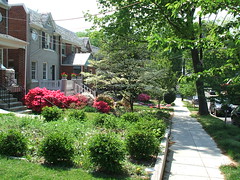
The neighborhood


The neighborhood
Originally uploaded by slack13.
Gotta say, this is a good time of year to get to DC. It was in the mid-80s yesterday, but no humidity yet, and stuff is flowering everywhere. Doesn't hurt we're a few blocks off a main strip but tucked away out of the traffic and our apartment back door opens onto a park.
I understand it's not always this nice - few people brag about DC's wonderful weather. But it makes for a nice introduction.

Friday, April 27, 2007

in with the new Busch

Caught a game at the new Busch Stadium yesterday, pushing the stadium total to 14 (a number that should jump rapidly soon, since I've only seen a game at one east coast stadium.

None of my Cardinal fan friends have been overly enthusiastic about the new stadium. Essentially on the exact site as the old one, the new Busch was designed with the same "retro" aestethic as every other new stadium since Camden Yards. The biggest knock against the old stadium, from a fan's perspective, was that it was a cookie-cutter round cement structure, just like the ones in Cincinnati, Pittsburgh, and other cities that built stadiums in the 60s or 70s (I'll have a chance to revisit the cookie-cutter look soon, at RFK). The biggest knock on the new park is, as one of my friends puts it, it's a "new Cookie-cutter". Since the elements designed to give the park "character" are the same as every other new park out there the park actually is devoid of any character.

Valid point. But I still prefer the new park to the old one. Got to see a day game in the bleachers yesterday, even if the weather wasn't perfect. Clouds hung in the sky most of the day, and the ninth inning was broken up by a 49-minute rain delay. The temperature reading behind home plate stayed in the high 70s, though, and for a few of the mid innings the sun beat down.
I reached my seat with a $5 hot dog and $8.50 beer in hand and looked around the stadium. Granted, there isn't any unique distinguishing feature to this park. But the brick facade and iron roof supports rising above the upper deck just look nicer than the old concrete ring of arches, even if every other park uses them.
Just being shiny and new and having 11 different kinds of concession stands will wear off. In 20 years, there might be calls for a new park as this stadium style falls out of favor. But it's going to age at least as gracefully as the Old Busch, and probably a little bit better.
For my money, there are two very important reasons this stadium is better.
1. It's obviously a baseball park. By the time I saw a game at the old Busch they'd torn up the artificial turf, put a grass bank in the outfield as the hitter's backdrop (a feature kept in the new park) and set up a shrine of rememberance in a few upper deck centerfield sections, featuring the team's Championships and retired numbers. They made it look probably as nice as you could make a cookie-cutter stadium look. But that didn't change the fact it was orginally built as a multi-purpose stadium. And it didn't change the most glaring deficiency of the old Busch, which was fixed with -
2. You can see out of the new stadium. The tiers of seating decks, skyboxes and club sections wrap around the field from foul pole to foul pole, but the pile of seating decks has breaks, visual interupptions, to allow spectators some view of the surrounding city. St. Louis has one iconic view - the arch. Now you can see it from parts of the stadium. The only place you could see the arch from the old stadium was if you climbed to the top row of the upper deck and looked out. This sounds like a small thing, but to me it's important for a stadium to have some sort of geographical identity. The new stadium might now have much unique character, but neither did the old one, and at least now you can tell with a glance which city you're in.


(A last point: Busch Stadium policy allows fans to bring in their own drinks, and I believe food. But the only place this is mentioned on the Cardinals website is on an "A to Z" guide of Busch Stadium under the letter I. For inspection (of bags). Obviously not a policy they're hoping people stumble upon.)

Friday, April 20, 2007

a plan

My work on the Springfield, Mo., ice storm disaster-recovery effort is done. (At least as officially as it can be - they never really tell you when you're finished, you just go "on call." But it's in the last gasping stages, and there's almost a zero chance of more work for me).
So I'm headed up to Columbia this weekend to relive my glory days. Then back to Springfield to finalze packing effort, then next week head to DC with stops in St. Louis and Indianapolis (hopefully a game at the new Busch will be involved). Then I'll land in DC just in time to ... well, at this point I have no idea what I'll be doing in DC. Looking for work and ways to earn money. Exploring the city, and reaquainting myself with the tourist spots I saw years ago. Piling through a to-do list that has built up since I just couldn't get myself motivated at the end of 12-hour days (or even the shorter ones). Perhaps a little road trip thrown in for good measure.

Monday, April 16, 2007

a destination, anyway

Almost five months after our return to the country, we've finally moved past crashing with friends and family without an idea of where we'd finally settle.
Kirsten landed a job in Washington, D.C., and that's where we're going next. (Well, she's already there. I'm hanging onto the job here in Missouri as long as I can, then heading east as well).
I still think of myself as someone whose rightful place is on the West coast, but I just keep moving further and further away. I think I'll manage - I'm happy to be heading somewhere where the metro population can be expressed in seven digits, rather than five.

Friday, April 13, 2007

the seasons, in the wrong order

When I started working this job in Springfield - early February - a few days started in the falling snow. It jumped straight from winter to summer; the last two weeks the temps have broken 80 a few times.
This week it decided to return to spring. We've gotten 45-55 temperatures and lots of rain. The problem is, after spending a few weeks touching the 80s, this feels a lot more like fall than spring. My internal thermostat has already been spoiled.

Tuesday, March 20, 2007

trees

We weren't in Springfield when the ice storm hit. We didn't live without power for a week afterward. But we were more than willing to profit from the severe weather when we learned there were temporary jobs available in the clean-up process. Especially since we had no other compelling reason pulling us to any other destination, and we were planning on coming to see Kirsten's family.

The ice had hardly affected Joplin, about an hour west, but as we approached Springfield all the large trees along the highway had been damaged. Limbs were broken, creating upside-down Vs spiking the top of the canopy. Some of the trees looked as though an internal explosion had driven the branches away from the trunk. A few reminded me of nothing so much as a Bloomin' Onion.

I've become well-acquainted with the effects of ice storm damage on trees over the past two months or so. Some knowledge about the trees themselves has managed to leak unbidden into my brain, but I've learned more about the inefficiency of this particular layer of the FEMA bureaucracy.

It looks like the job is winding down. No more watching crews cut trees, or haul away the broken limbs, documenting every step. Hopefully no more waking up at 5 a.m. (or 5:45, once daylight savings kicked in) once I'm finished here.
The last few days the weather has given me a reprive - thunderstorms have halted work. The work is almost finished up anyway (only a little more than three months after the storm) so I might be done any minute. I won't be sorry when it's done, but I'm willing to earn a few more paychecks before it is.

Sunday, March 11, 2007

radio

For the last month, I've been driving a car with Sirius satellite radio. It has one channel of particular interest to me: the international radio channel. Particularly the Irish and Australian broadcasts, since we listened to those channels while in rental cars in their lands of origin.

Since we've gotten back to the States, the travels have receded into the background of my mind (especially now, while working 12 hour days - everything has receded into the back of my mind as a sleep-deprived haze has blocked out most of my thoughts). Listening to foriegn radio, however, brought on a kick of nostalgia.

Also, a bit of a realization: listening to two commentators debate on Irish radio, I actually heard one concede a point to the other. When's the last time that happened on any program in the States?

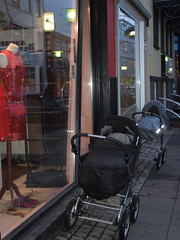
baby buggies


baby buggies
Originally uploaded by slack13.
We ran into these buggies outside the shops in Rykjavik. It's interesting enough to me that they still have buggies such as this, rather than the super-decked out strollers I see here. But wait, there's more.
There were babies in these. Left outside the shop. With no supervision. In November, in Iceland.
People would go nuts here. In fact, someone told me there was a case where a European tourist was chared with child neglect by New York police for doing the exact same thing. But apparently it's considered bad form to disturb others' shopping experience by bringing a baby in the store.

It's a refreshing attitude.

Thursday, February 22, 2007

tired

Obviously, I haven't kept to my goal of regular posting. At least now, I have a semi-excuse. In order to make some cash K and I picked up a short-term job in Springfield, Mo. Ice storms a few weeks ago were bad enough to earn a disaster designation from FEMA, which means FEMA is picking up the tab to clean out all the tree limbs. Of course, because it's FEMA, it's not an easy process. Which is where we come in -we're earning cash watching the crews doing the actual work, doing our part to add another layer of bureaucracy to the process. Not a bad gig, since we're not really doing any actual work other than filling out paperwork, and not bad pay. Bad hours, though. About 12 of them each day, six or seven days a week. Last week, I put in 74 hours. Even without doing hard work during the day, I don't have much time to do anything else. Certainly not enough time left over for sleeping, as far as I'm concerned.

Monday, February 05, 2007

bands around the world

Oct. 4, 2006

A poster caught our eye in the Beijing subway: Rock and Beer Feast 2006. Almost all the poster was in Chinese characters, rendering the information useless to us, but we managed to figure out there was a week-long, all-day music (and beer) festival somewhere in town while we were there. (and calling it a feast, instead of the more conventional fest, just made it more appealing).


In the English-language mags we found a bit more information, although still tantalizingly little: yes, it was a week-long series of concerts starting at about 2 p.m. each day. More importantly, the venue (listed as "International Sculpture Garden") was accessible by subway, the only way we could navigate Beijing. And the entry fee was less than $10.
Wednesday, we lounged around the apartment all morning. Since most of the day was shot already, we figured we'd head out to the feast to make it sound like we hadn't squandered all our time. In our mind, we figured we'd lie on the grass, listen to a couple of bands (since we had no idea what to expect, we went in figuring the quality would be poor. No chance of disappointment) and then maybe leave and figure out something else.


We showed up about three o'clock. The venue was easy enough to find, since it was literally just outside the subway stop. The "sculpture garden" ended up being an airport-sized piece of fenced-in concrete; not the perfect place to hang out in the 80-degree sunshine. A group of maybe 100 kids sat in front of the stage at one end of the cement, watching a punk band fronted by a high-school aged girl. A few more sat by the two beverage tents in the middle of the area, about 300-400 yards from the stage. The far edge was ringed with tents selling food and merchandise. The crowd seemed to be primarily 16-22 year olds, with enough exceptions to make it interesting. All in all, pretty typical. Except we were the only white faces there (a few more, looking like international college students, showed up later in the evening). And the beer sellers, who were using some sort of purchase-tickets-then-exchange-tickets-for-beer system, didn't speak English. And I didn't understand a word the bands were saying (actually, I suppose that is pretty typical).

A few bands into the day (each band got about a half-hour set) we were treated to our first taste of the bizarre: a goth-metal band, lead singer dressed in what I'm guessing was a traditional western Chinese costume (to my eye, it looked a bit like Native American garb) and everyone else in full white face paint. A few power rock chords, then out comes the traditional Chinese violin. Nice touch.

The bands weren't bad, generally. We figured out how to buy beer (3 yuan, or about 35 cents, for a big bottle of beer; 5 yuan for a smaller bottle of water). A girl at the refreshment tent took the opportunity to practice her English, helped us navigate our way through the selection and translated the names of some bands. She also keep asking us if we liked the music, near incredulous as well as excited at our answer of yes.

Just after dark came our favorite act of the night. It didn't hurt when they broke into a pop-punk cover of "You Are My Sunshine," one of three English-language songs the whole day. (I honestly can't remember what the first one was, but the other one was "Cat Scratch Fever" sang by a hard-rocking Chinese who, I'm convinced, didn't know English or have any idea what he was saying).

Many, many beers and about eight hours later, we even managed to negotiate the subway properly and make it home.


Nov. 8

Since even before we left New Zealand, it seemed like we were continuously visiting cities where a band one of us wanted to see had just been or was just about to arrive; either way, not while we were actually there. In London, we checked the gig guides and the sites of several bands we knew were touring. Again, all of them were going to miss us by at least a few weeks.

Kirsten checked on one more band, and found it, too, would miss us, playing in London while we would be in Newcastle. Then we looked at their schedule, decided to see where Gateshead was, and found out it actually was in Newcastle, at the same time we were going to be in Newcastle. So, finally, a happy coincidence and a show we wanted to see.

The show was in the Sage Gateshead, a brand-new venue on the south side of the Tyne River. From the outside, the steel-and-glass structure looks a bit like a giant, shiny slug. From the inside, it offers a brilliant view of downtown Newcastle as well as three concert halls.

The show itself, the only one on our trip we bought tickets for ahead of time, was a bit of a disappointment. I've heard Yo La Tengo's album tracks before, and I generally like them. Live, I felt they should have taken the distortion pedals away from the lead singer. There was more noise than music, and from a band whose lyrics are probably the strength, when you can't hear the lyrics it's a problem.


Nov. 11

It looked like we'd have our usual problem as we headed to Ireland. There was a band our friend Ryan had introduced us to. We discovered they'd be playing in Dublin the first weekend we'd be in Ireland. However, plans changed and it turned out we were in County Cavan the night of the show, rather than Dublin.

Our Irish friends told us they'd be taking us to Galway the next night, to see the reuniting show of one their brother's bands - they were opening for a touring band at a Galway pub. (Unfortunately for me, the name of their band has left my mind. Sorry, Alan.) We arrived in Galway a little late, and the band we came to see was off the stage. We decided to head in anyway, since two of us were on the guest list and the remaining cover wasn't that bad split between all of us.

We walked in the pub and saw chaos on stage. There were nearly 30 people up there, most of whom had no instruments (save kazoos) but were singing, blowing bubbles, throwing confetti and dancing like mad. I figured they'd grabbed a bunch of fans out of the audience. The crowd was into it, the music was catchy. It also sounded a little familiar.

Now, Ryan had only given us I'm From Barcelona's music. We had no idea what the band make-up was. So after a couple songs, when a very familiar song starts playing, Kirsten leaned over to me: "They're covering I'm From Barcelona!" Then we started to wonder. I leaned over to one of the Irish boys: "Who is this band?" "Barcelona something!"

We'd stumbled across the show of the band we'd meant to see, without any idea we were going to. It also ended up being one of the best shows we'd ever seen.