Thursday, July 06, 2006

Photo update


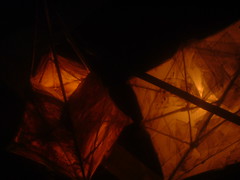
Lanterns
Originally uploaded by slack13.
I've also put a few new photos up on my Flickr page, including a number of photos from a Mid-Winter Carnival they held here in Dunedin a couple of weekends ago. The highlight of the festival was a procession of lanterns (to chase away the longest night). People could make their own in the weeks preceding the festival, then parade along with several larger lanterns in all shapes. The night was capped off by fireworks.

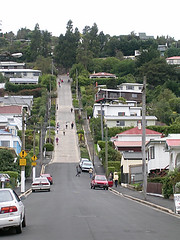
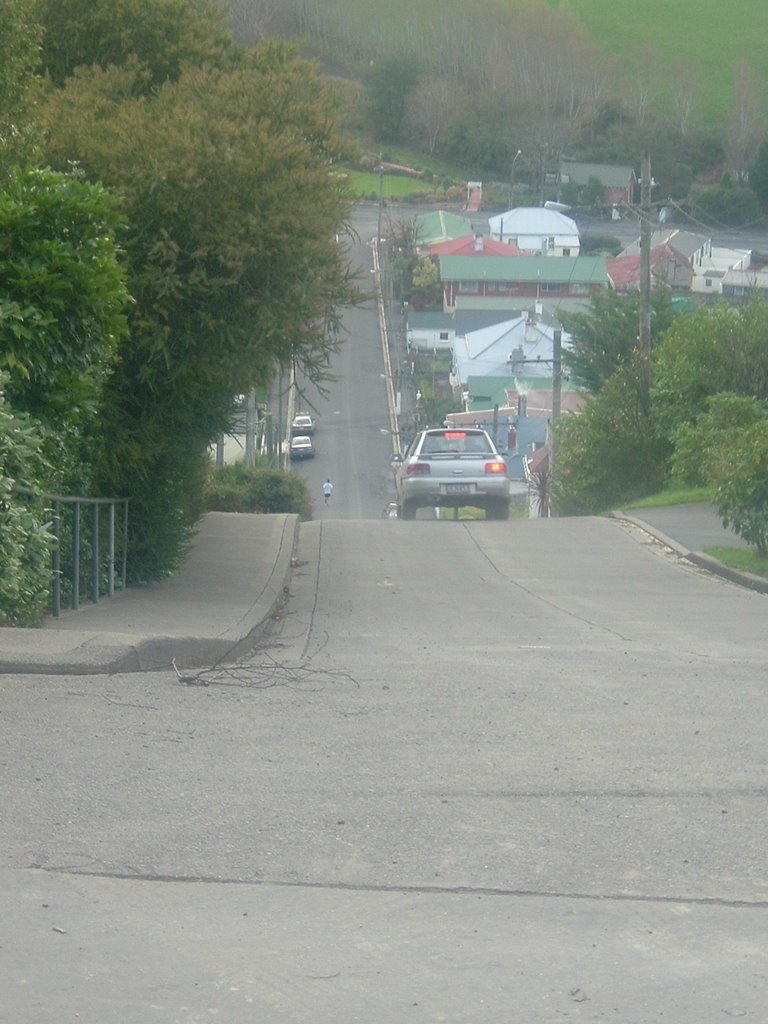
Someone else's view from the bottom

Since I didn't take a photo from this angle...

getting my travel photos up to you


I haven't been very good about putting up photos lately, so I'll try to remedy that in the next couple of weeks.

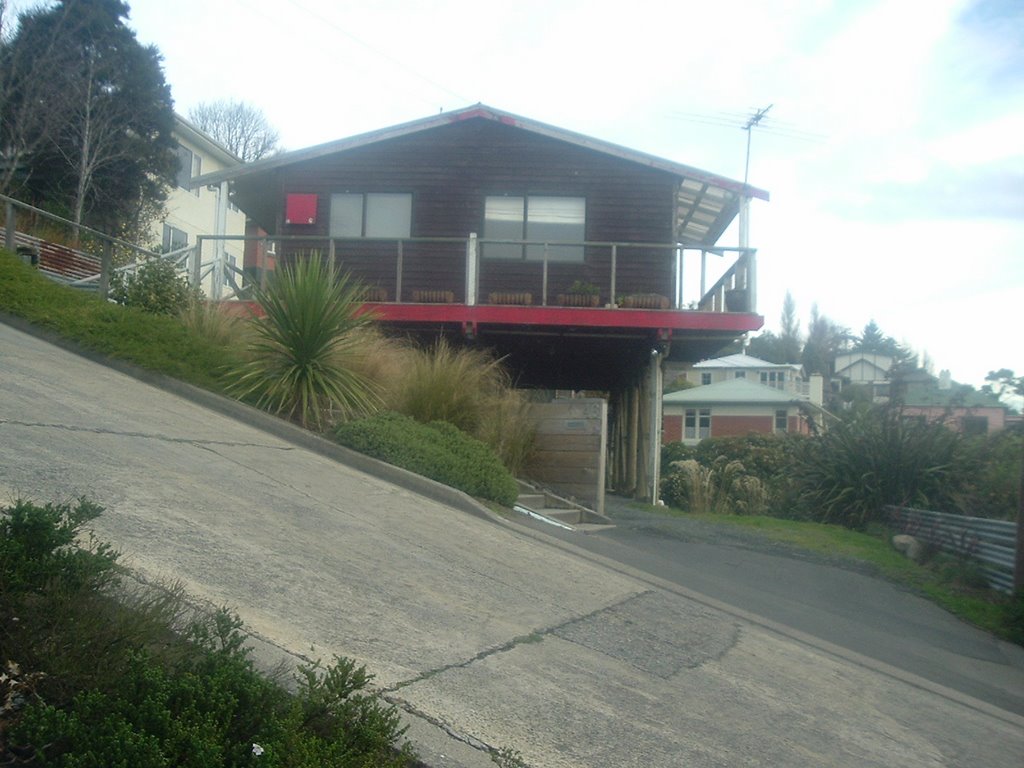
I will give you a few now - these are from our trip to the World's Steepest Street (apparently it's in the Guiness Book of Records, but I've never actually checked) across town.

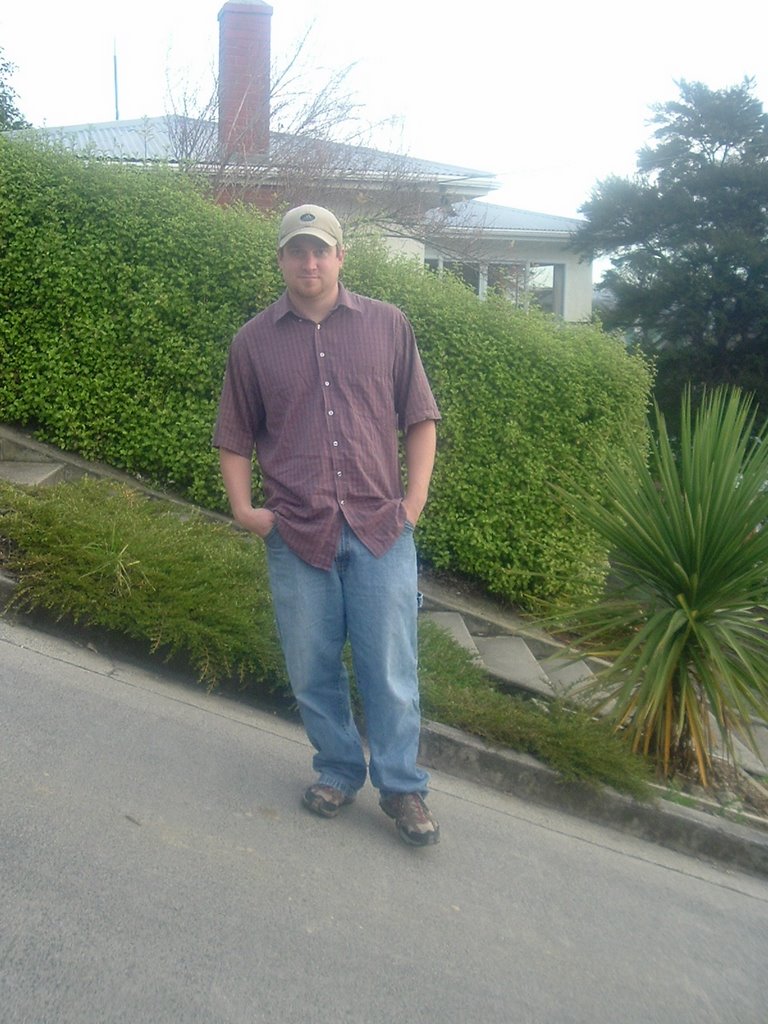
We walked up the street - then back down. Apparently it's about a 1:1.26 gradient, which means it's damn near at a 45-degree angle. All I know is that it's a steep walk. And it seems crazy to me the number of driveways with cars in them just off the street - that's a hell of an end to the daily commute.


and hopefully they'll be staying...

Sometimes I forget how rare it was back in the States to meet people from another country who were just traveling around. Here, especially when you're traveling yourself and are on the tourist circuit, you meet almost no one else.

Today, I stopped by the city library. A girl was applying for a library card. I overheard the woman behind the desk tell her:

"You have to put down the contact information of someone who knows you. And they have to be in this country."

Wednesday, July 05, 2006

the rugby

We haven't done a lot in terms of cultural travel the last few weeks.
We've mostly been hunkered down working (temp jobs) in Dunedin to try
and put a bit of cash in our bank account before we start to travel
and drain it all.
This weekend, however, we have an activity planned that I've been
looking forward to since we arrived in New Zealand.
We're going to see the All Blacks. The haka. Rugby, New Zealand vs.
Australia, in Christchurch.

Tuesday, July 04, 2006

coming up

Our time in New Zealand is almost drawing to a close.
We're working for two more weeks in Dunedin, then packing up and heading to the ski fields before taking the hard steps: packing for the next few months of travel, sorting the things we don't need for sending home, selling the car.
We came here with a relatively heavy suitcase and a backpack each. Considering we were coming for a year, it wasn't an outlandish amount of stuff, but there were some clothes packed we never needed.
Now we face an even tougher packing job. Since we're not flying directly back to the States, we can't drag as much with us. In another instance of the States supersize culture and the willingness of companies to accommodate it since we mean so much money, flying to or from the States gets you more than double the luggage allowance than flying anywhere else. So we have to cut our two heavy bags down to one bag of less than 20 kilos each.
The process has already started. We mailed a some clothes home and gave some away when we left Wellington to come to Dunedin, and I left my (older and battered) suitcase in the donations pile.
We've still got a long way to go, however. The bags we still have with us have disgorged enough contents to fill our room in the hostel. We'll also have to somehow pack for summer and winter conditions over the next four months.

We'll leave New Zealand the first week of August for nearly a month in Australia. Early in September we'll fly north to Bangkok and spend two or three weeks in Southeast Asia before flying to Beijing.
A couple weeks in China and then we head to Europe. We plan on spending time in Germany (hopefully seeing our former flatmates) and several areas of the UK and Ireland, trying to stay with friends we've met here and elsewhere.
Then back to the States in late November or early December. And then I have no idea.

Monday, June 26, 2006

now I'm saying it

It is the most uniquely Kiwi piece of slang there is: "Sweet as."
(When you first arrive in this country, you hear an extra "s" on the end of the phrase).

It's used the same way I used "no problem," or "that's cool" or even just "sweet."
It can be used as a descriptive expression: "That skydive was sweet as!"
or as a statement to express a laid-back contentment: "Sweet as, bro."

There's never any indication of what it might be as sweet as, of course. The construction can also be used with just about any adjective, usually to express how intense something was.
"Yesterday it was cold as, man"
"Last night I was drunk as"
"That guy is crazy as, bro"
"Your coffee is bitter as"

Mostly, however, the "as" only goes with "sweet." And once you get used to the expression, it's quite handy.
It's sweet as.

Friday, June 23, 2006

it was moderately entertaining

When we were traveling around the North Island we picked up a brochure for a private Elvis museum - basically a guy obsessed with Elvis letting you pay to see the collection of stuff in his basement.
The funniest part of the whole thing, however, was a list of television programs that have featured the collection.

No. 1 on the list: a show with the not-quite-enthusiastic title, "That's Fairly Interesting."

Apparently this was a New Zealand-produced show some years ago. It's a good illustration of a certain bit of the Kiwi character, a knack for understatement and a fear of appearing too proud. After all, you wouldn't want to advertise something as being can't miss and disappointing your audience. Better to be safe and underwhelm.
For someone used to American hyperbole, the title amuses me every time. I am just picturing a old gentleman of the English type coming on my TV screen on Sunday afternoon, introducing a piece on a local attraction, then after the piece airs coming back on, and in a slightly hopeful tone of voice, suggesting he regrets taking up your time and hopes you don't blame him, saying,
"Well, That's Fairly Interesting."

world cup fun

One of my favorite moments as a sports spectator came four years ago in a New Orleans Irish bar filled with Brazilians.
It was the final game of the 2002 World Cup, between Germany and Brazil. The game was being played in Japan or South Korea (I don't remember which country hosted the title game) and so kicked off at 5 a.m. New Orleans time.
My buddy Wright and I started the night before, with the goal of ended up in the Quarter at a bar we were told had been adopted by the local Brazilian community for the tournament.
We showed up an hour before game time, and the bar was nearly empty. But in the next half hour or so, every square foot in the bar was packed and everyone was rooting for Brazil.
Fans hung flags and banners, chanted throughout the game and there was even an air horn among the crowd.
It was all of the best aspects of watching sports: a roomful of strangers turned into best friends, united in every Brazil attack, euphoric at each Brazil goal. I would have barely cared about the result if I'd watched the game at home, but in the midst of the revelry, I could share in the euphoria of the contest and eventual victory. The fact it all happened between 5 and 7 in the morning just added to the atmosphere of the whole event.

I'm reminded of that World Cup fairly often during this one. Not because I've had any experience similar so far this time around, but simply because the games are once again at an impossible time.
Four years ago, it was impossible to casually watch any of the World Cup, because all the games kicked off sometime between 2 a.m. and 6 a.m.
Four years later, it is impossible to casually watch any of the World Cup, because all the games kick off sometime between 2 a.m. and 6 a.m.
Yes, somehow I've managed to once again end up on the opposite side of the globe from the World's Biggest Sporting Event. It takes dedication to watch sports at times like those. You either have to stay awake until the game finishes or force yourself to wake up at strange times.
Unusually for me, I've actually had more luck waking up at odd hours. Last night, for example, I dragged myself out of bed at 2:45 a.m., after about three hours of sleep, to head out and find a pub showing the US/Ghana game. (The first-round games are only showing on cable, which the hostel doesn't have).
I wandered downtown to my first choice, only to find the bar was only showing Italy playing the Czech Republic. I headed to another pub rumored to be open, to find the US game on a big screen in a back room.
There were about 15 fans watching, most of whom appeared to be displaced Americans (I'd guess most were studying abroad at the University here). I didn't arrive until halftime, however.
There was no opportunity for bonding through sport here. With the States down 2-1 and needing two goals to advance, the mood wasn't celebratory. I watched a mostly desultory half of soccer before heading home for another four hours of sleep.
Regardless, I'm glad I headed out. I feel like I've achieved something each time I say I'm going to watch a game and actually manage to do so. And even when there isn't a celebration, there's something about wandering the deserted early-morning streets, opening the door to a bar open specifically for World Cup fans, and finding a group of people who are just as idiotic as you are to be up at a time rarely seen simply to watch a game of soccer.

(One of the best single moments of watching that game with the Brazilians: There were two constant chants from the crowd. One was easy to pick up: Ole, Ole, Ole, Ole, Bra-zil, Bra-zil.
The other I couldn't make out, After about 30 minutes, I turned to the fan sitting on my right.
"What are you chanting?"
"Oh, that's 'Fuck the Germans,' in Portuguese."
I think that's a phrase that should be in the guidebook for every country. It seems like a sentiment most of the world is united behind.)

Monday, June 19, 2006

lights on the old museum


lights on the old museum
Originally uploaded by slack13.
I just like this photo. It was taken several months ago in Wellington. This is the old museum, which is now part of Massey University. It was also across the street from my old apartment. When King Kong had its New Zealand premiere, this was the site of the cast party, which is why it was lit up like this. We wandered by the night before, when they were setting up the lights.

hills and cold

I've gone from one city built up and down hills to another.
In a few ways Dunedin is like a smaller version of my other New Zealand home, Wellington. Both are nestled between hills and a harbor, both lay claim to a better nightlife and music scene than their size would normally call for. And both have a reputation for leaving something to be desired in the weather department: Wellington for wind and Dunedin for cold.
I realized the other day I'm almost exactly as far away from the equator as I was growing up in Montana. Dunedin lies at 46 degrees South. Geraldine, Montana, is 47.6 degrees North.
Since I'm about 1,000 miles closer to an ocean here in Dunedin, it doesn't get quite as bitterly cold here. But after four years of living in Mississippi all the natural antifreeze built up by my upbringing has left my blood, so the near-freezing temperatures here are testing my body's ability to cope. Fortunately, the hostel has wood fireplaces so I can blast heat into a room without having to curse the Kiwi lack of central heating.
Unfortunately, the hostel sits at the top of the hill overlooking downtown. I've had to trudge up and down (it feels like mostly up) more hills here than I usually did in Wellington, since we lived in the relatively flat central city. If we choose to take the elevation on all at once, the sidewalk at the end of the street turns into a staircase with 169 steps, which leads to another set of about 30 steps. Otherwise, we just walk up a constant grade to get to the same place.
On the plus side, the city really does seem like a fun place to go out in, when I get up the motivation to brave the stairs.

Tuesday, June 13, 2006

driving oddities

We may not have had a car for most of our time in New Zealand, but we have been subject to some of the oddities of New Zealand's roads from the beginning. Road trips in rentals or other people's cars, and now our own, clued us in.
There were a number of strange rules and regulations to get used to: obviously, driving on the left was the biggest one. Also mandatory stops at pedestrian crossings on the highways as well as city streets.
The strangest rule is one unique to New Zealand, at least according to the guidebooks. If two cars facing each other at an intersection are both turning the same direction, the one turning right has the right-of-way.
For those used to driving on the correct side of the road, picture this: You're at a red stoplight ready to turn right (in New Zealand you can't make those easy turns, which are left turns here, against a red light. Ever.). Another car, facing you, has it's blinker on to turn left. You're both going to turn into the same lane. So, obviously, you have the right of way. Right?
That's not how it works here.

Another oddity is just how well people follow directions. Those pedestrian crossings, for example. In theory, crosswalks in the States work the same way. But rare are the cars who stop at them, especially on a busy street (when you can find a crosswalk on a busy street). Here, the crossings are everywhere, and everyone stops.
Kiwis also have a propensity to have a two-lane road turn into one lane immediately after an intersection. If there's much traffic in both lanes, as there often is, drivers are expected to effortlessly complete the transition by alternating cars from each lane. Traffic signs urge you to "merge like a zipper."
Amazingly, everyone does.

Tuesday, June 06, 2006

touring along

This was the weekend of the afternoon drives.
Dunedin is situated at the end of a long, narrow harbor formed by the jutting thumb of the similarly long and narrow Otago Peninsula. This weekend we explored both sides of the harbor; on Saturday we drove out to the end of the Peninsula, and on Sunday we drove along the mainland side to the harbor entrance.
Then on Monday, which was a national holiday here as New Zealand celebrated the Queen's Birthday (which was actually in April - don't ask me), we drove further north up the coast and then west into the rural mountain landscape.
By the time we took off Monday, Kirsten remarked she felt like an old couple going out for a Sunday drive. I figured since it was actually Monday, we were all right.
Saturday was a day for animal-spotting (and the only day we paid to be tourists). At the end of Otago Peninsula is an Albatross breeding ground, the only one in the world that's not on a remote, inaccessible Sub-Antarctic Island. This is where the payment bit comes in - you can only see the nesting area on a guided tour.
We'd been here once before. On Christmas Day we drove out to the end of the Peninsula in driving raid and a cold wind, and caught a glimpse of the albatross loving life and gliding through the air. The worse the weather is, the better if you're an albatross, apparently.
This time around, we were told it was unlikely we would see any adult birds, as they no longer are feeding the chicks more than once every few days. This is because the chicks have been fed so much in their first few months of life they're now fat bastards, weighing more than their parents. They're still covered in down and haven't grown their real feathers, so they don't fly, barely move and are now on a diet.
We got lucky. As we walked into the observation shed, we saw an adult standing next to the one visible chick (which really was just a fat ball of white fluff, at least as big as the adult). It was there just a minute or two, before taking off and flying out of sight.
It wasn't the end of our wildlife viewing, however. Next to the parking lot for the albatross center is a small beach. After sunset, a number of Blue Penguins, the world's smallest penguins, came ashore. There was just one small problem: it was a dark moonless night, and it kept getting darker. We could just make out the first penguins, which were only about a foot and a half tall, but after that all you could see was the blue flash of the later arrivals' bellies. We did get to hear the penguins after we could no longer see them.
Sunday was originally going to be for finding some walks along the coast, but a bitterly cold wind started to blow, bringing with it occasional rain, so we were content to stay in the car.
Sunday night Dunedin picked up some hail with it's rain, and when we woke up there was actually a dusting of snow on the hills around the city.
Our Monday Sunday drive led us up to the Moeraki Boulders, a group of perfectly round rocks, about four feet across, lying in the sand. They are impressive on first glance, then they become just a group of big rocks on the beach. We headed back to Dunedin on a scenic route into the hills, passing a huge open pit gold mine as well as the ruins of settlements from a late 1800's gold rush in the area.
Sure, we didn't get out of the car much. But we saw quite a bit of the area, and after all, it was cold.

island life

New Zealand is a Pacific Island nation. New Zealand is not a tropical island nation, although it sometimes pretends it is.
This might be something visitors fall prey to more than native Kiwis. To an American, New Zealand looks like it belongs with Fiji, Samoa and all the rest sitting all the way across the blue expanse of the Pacific. At the very least, New Zealand is lumped in with Australia in our geographic mind.
It's easy to overlook the fact New Zealand's Southland is nearly as far away from the equator as Canada.
New Zealand is not a tropical island, but there is a small bit of the easy-going island mentality here. Sometimes the mentality is here defying all logic.
This was the case the other day here in Dunedin. Mind you, there was a dustin of snow here yesterday. Temperatures have been around and below the freezing point. But there he was, hanging on to the island ideal, a New Zealander to the core, pulling on a winter coat, bracing against the bitter wind...
And wearing flip-flops.

Thursday, June 01, 2006

dunedin view

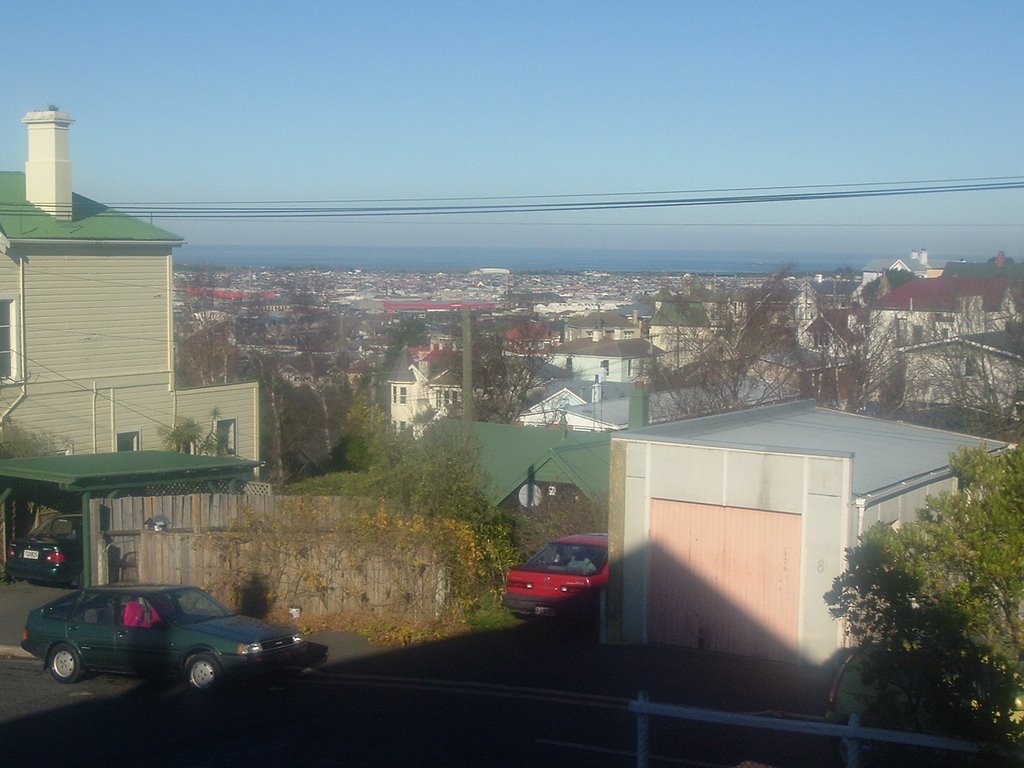
This is the view from our hostel, which is located on a hill above the city center. Looking from the front door, you look over the city to the Pacific Ocean. If you turned left, you'd look toward downtown and the harbour, which is sheltered from the ocean by a long, narrow peninsula.

Tuesday, May 30, 2006

more pics

They are overdue, I suppose - photos from our trip around the North Island in April and early May:


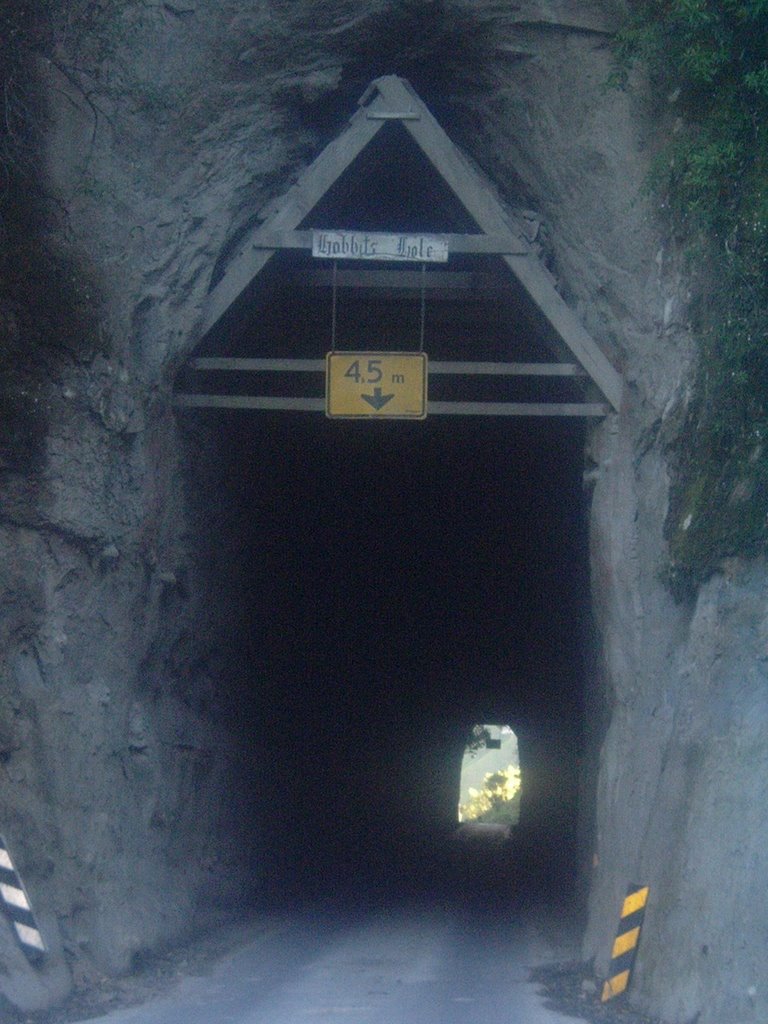
A tunnel at the beginning of a long side trip we took on a gravel road through the mountins off the "Forgotten Road Highway" heading east from Mt. Taranaki. The one-lane tunnel is nicknamed "The Hobbit Hole."


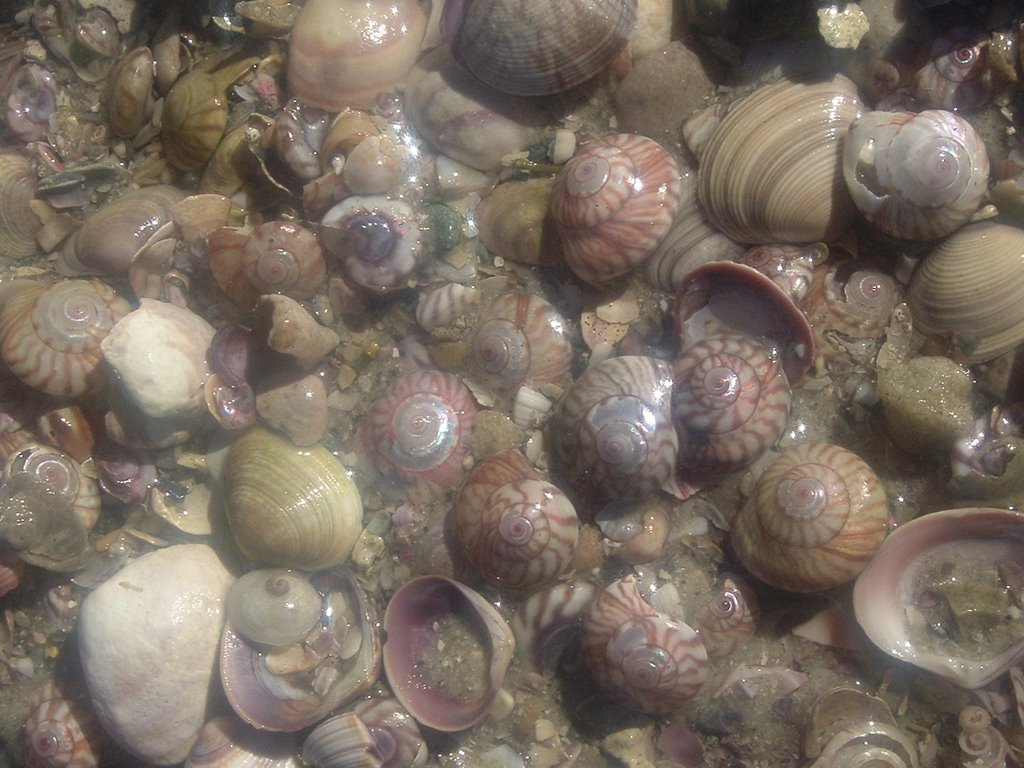
Shells on a northern beach.


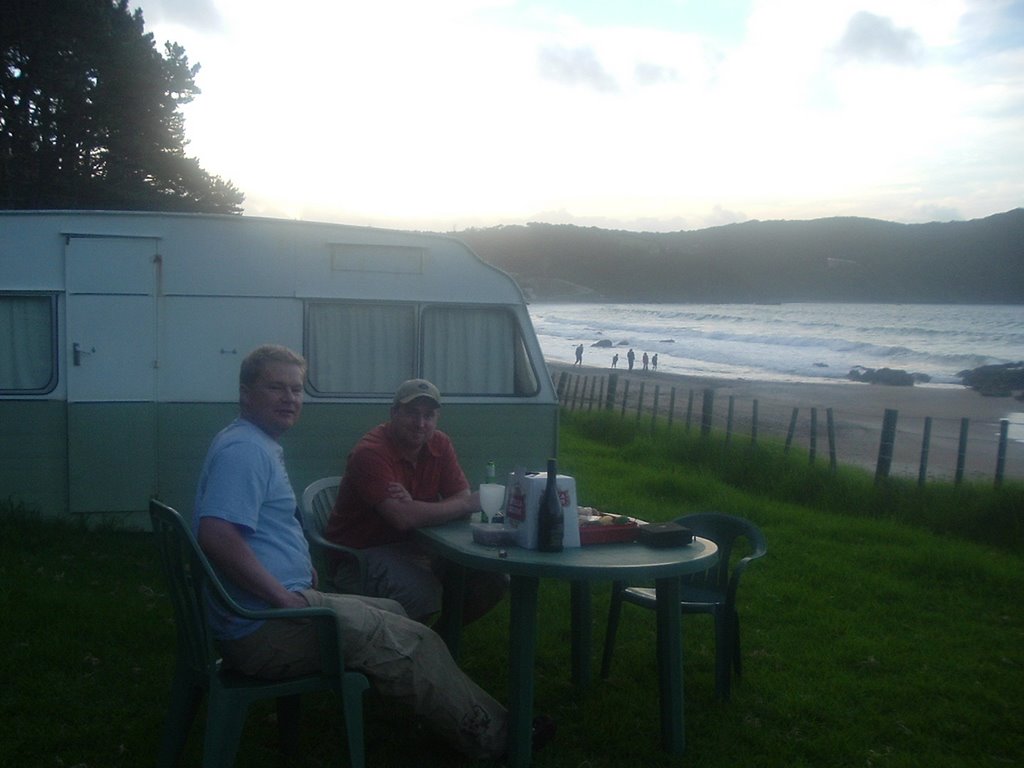
Our friend Andrew and the beach where he put us up.


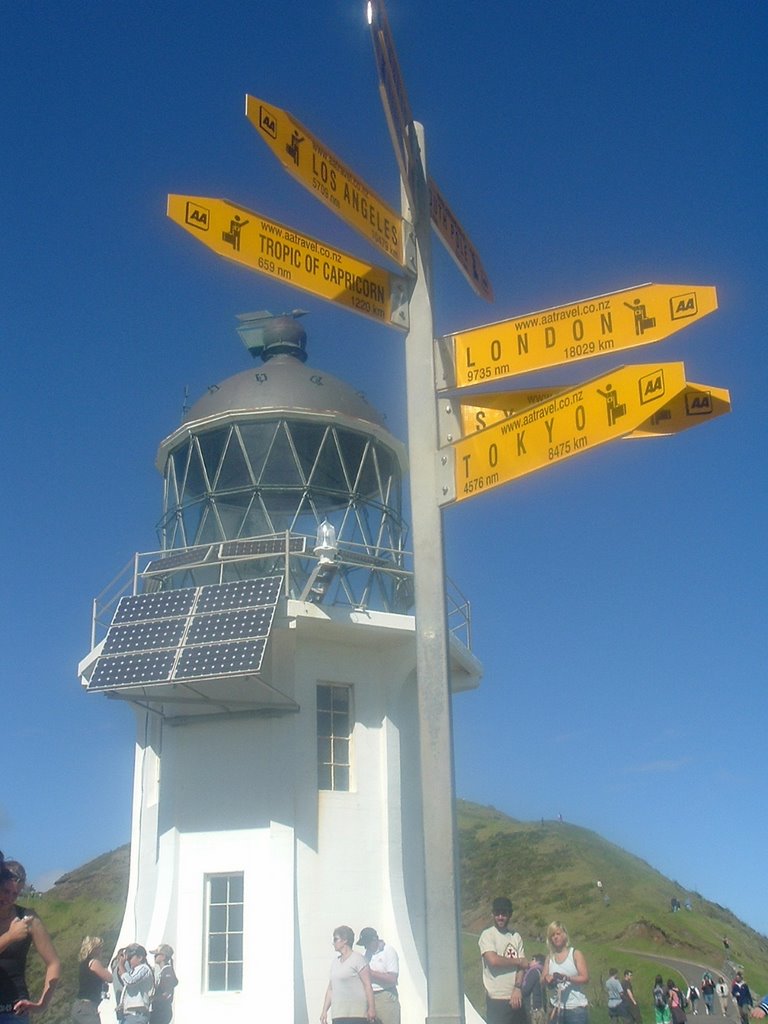
The lighthouse at Cape Reinga, top of the North Island.


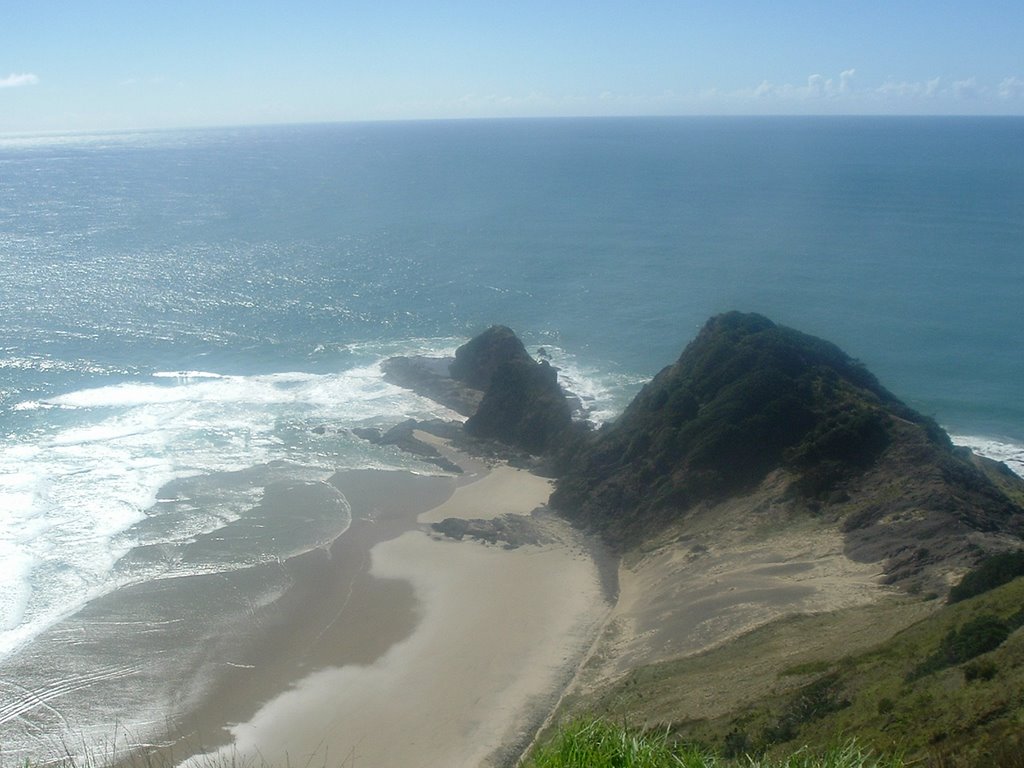
The tip of New Zealand.


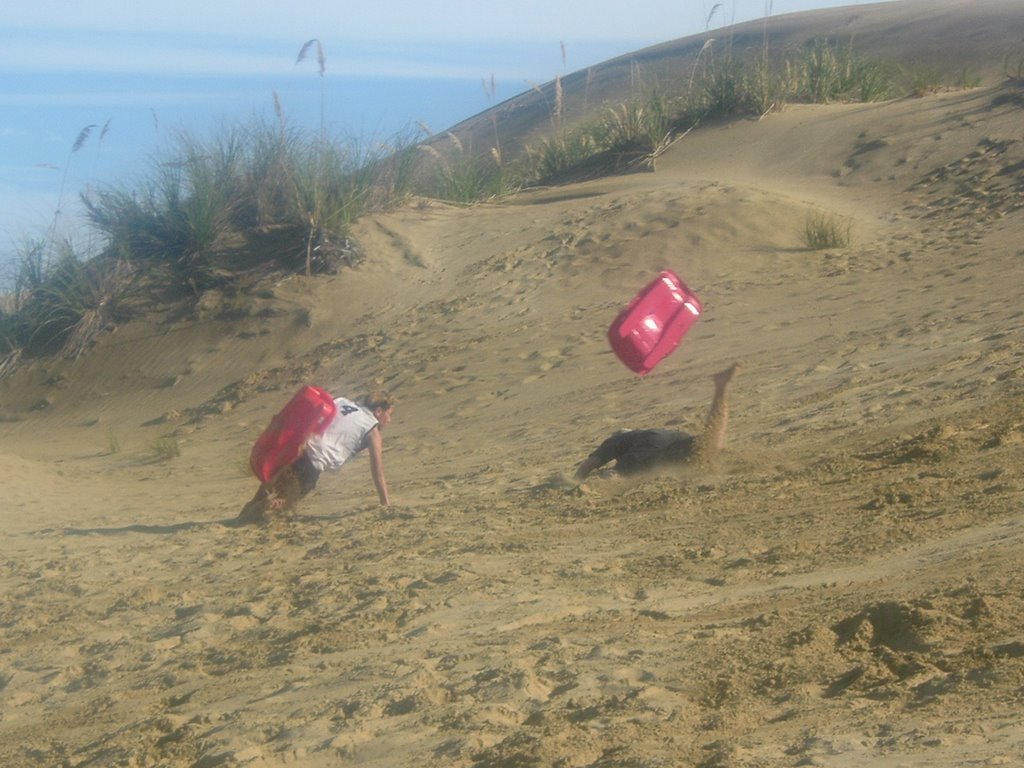
I'm the one facedown after trying to sled down a giant sand dune on the 90-mile beach, a long beach (but not actually 90 miles long) running down the west coast of the northern tip of New Zealand. As you'll see later, the beach also serves as a highway with it's hard-packed sand.


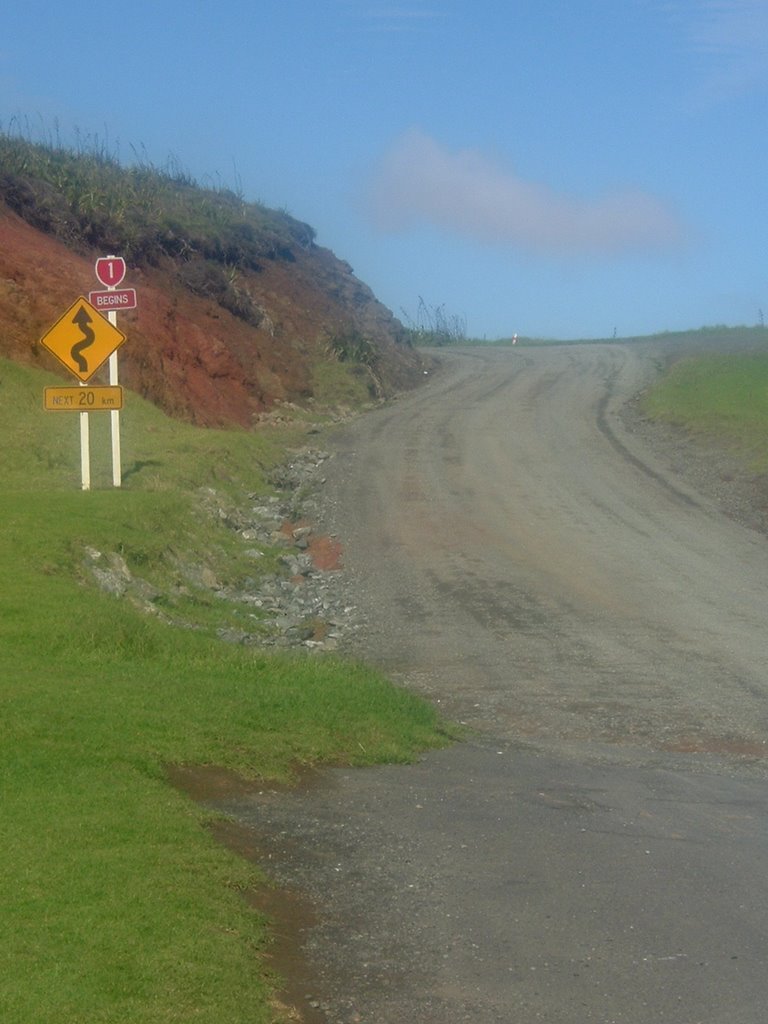
This is the start of New Zealand's State Highway 1, the main artery of the country. For the first 20 kilometers, it's a gravel road.


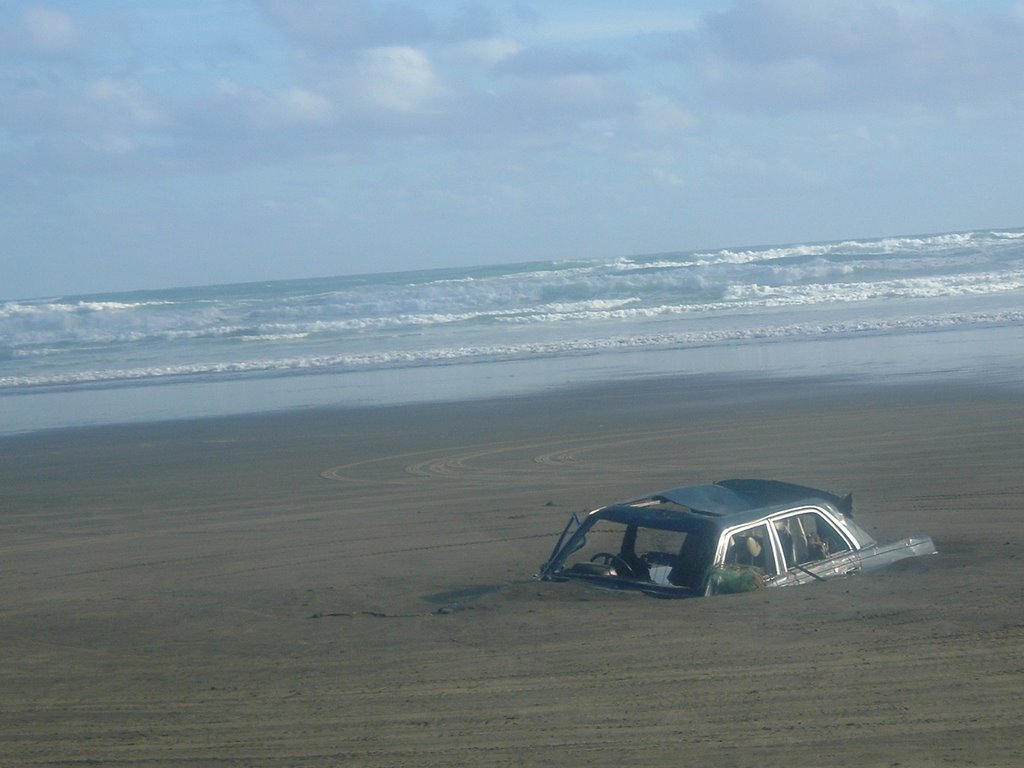
Someone who tried to use the 90-mile beach as a road and didn't quite make it all the way. Supposedly this car had only been on the beach for about six weeks. However, every day buses go up and down the beach (this photo was taken from a bus window). The secret is to know the tide times and not get caught in the water.


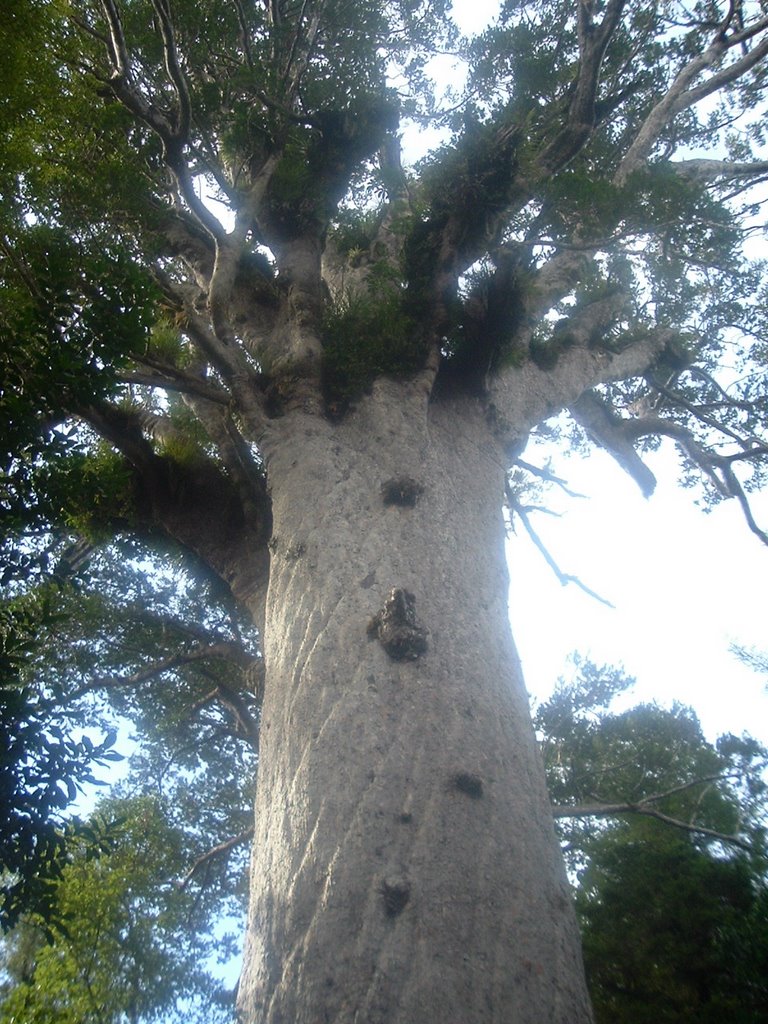
Tane Mahuta, the largest Kauri tree in New Zealand. It's similar in size to the California Redwoods, although not quite as tall.


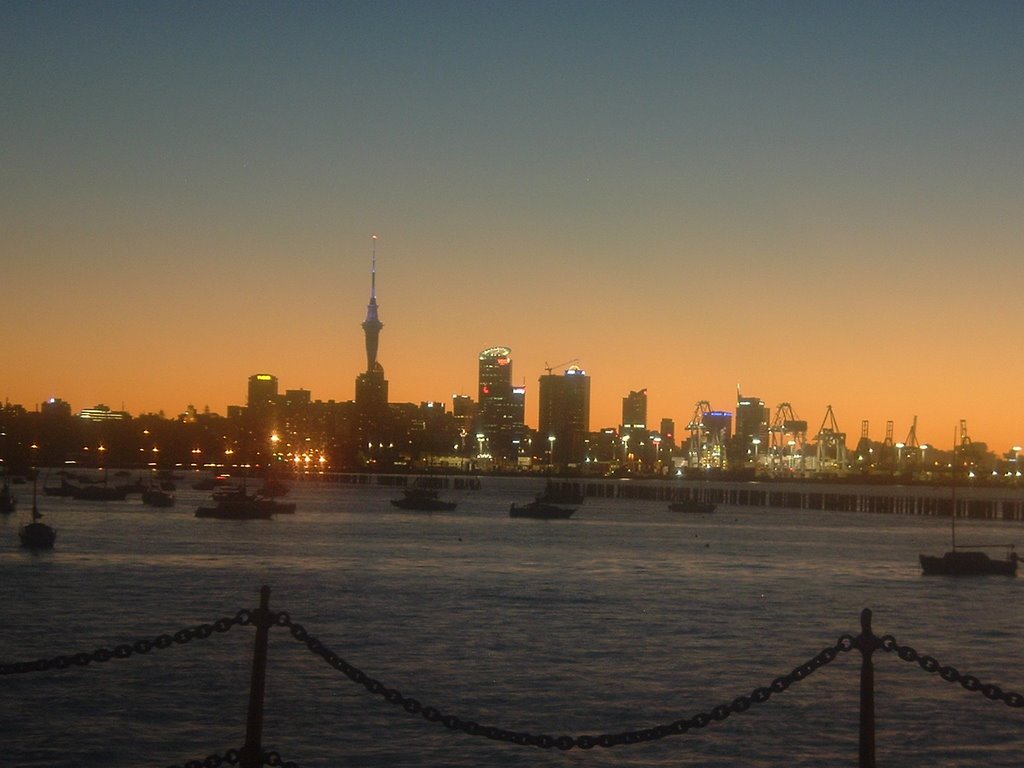
The Auckland skyline at dusk.

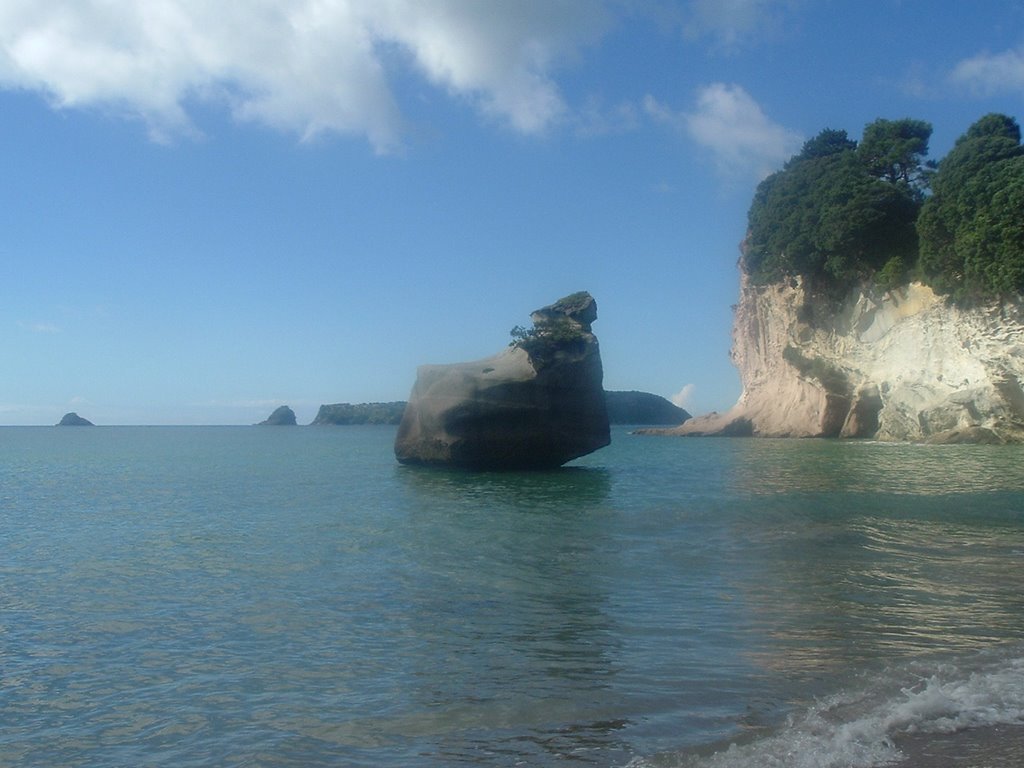
Cathedral Cove.

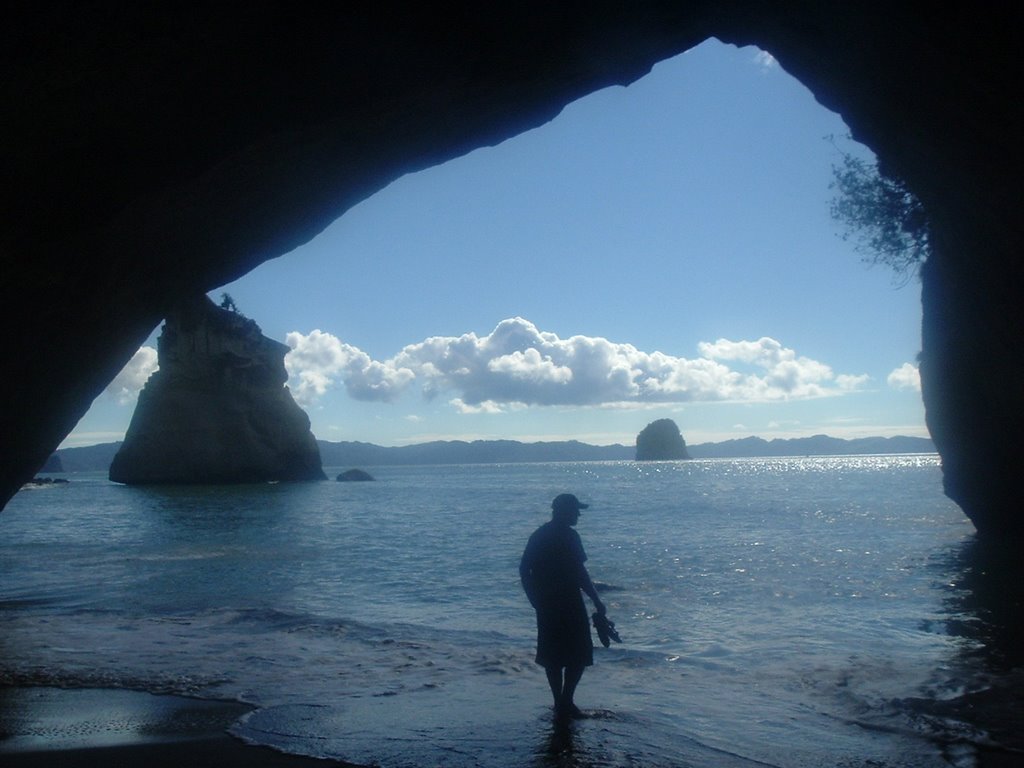
Me at Cathedral Cove, on the east side of the Coromandel Peninsula on the North Island. This was our last day of the road trip. The beach, one that we'd seen many times before in tourism photos without realizing where it was, is secluded at the end of a 45-minute walk. That day was warm - people were wearing swimsuits and bikinis. Two days later we were in Wellington, where we couldn't go out without coats.

Thursday, May 25, 2006

a new point

We're gone from North to South. Left Wellington, packed even more stuff into the car, got on the ferry, and drove most of the way down the east coast of the South Island, stopping in Dunedin.
Dunedin seems a nice enough place - it's New Zealand's version of a college town. About 100,000 population along with 20,000 Otago University students. We haven't had a chance to see if those students actually give the town any life; since arriving on Tuesday we've mostly been holed up in bed trying to shake colds which have plagued us for a week now. We're also doing a bit of cleaning in exchange for free beds at a hostel. That's the reason we ended up in Dunedin: we didn't have any real idea on where to go, and this was where we found free accommodation.
What I can tell, however, is it's an interesting city visually. It was founded by Scottish settlers in the 1800s, and there are plenty of big, imposing, European stone buildings around town. It's also built on shoreline hills - Dunedin claims the world's steepest street (which I haven't seen yet). And outside of town is the large Otago peninsula, home to the world's only mainland Albatross colony (if you consider New Zealand a mainland) as well as two kinds of penguin, one the world's rarest, sea lions, seals, and all sorts of other things to look at.
It's not the first time we've passed through this town. Dunedin is actually where we spent Christmas. Five months ago, the town was cold, grey, and our car broke down. Now it's cold but sunny, and our car is working so far.
(knock on wood)

talking about Wellington

Now that I've left Wellington, I figure I may as well tell you a little about the city I spent more than half a year in.
This is a story I wrote intending to sell to a paper, but haven't yet:

WELLINGTON, NEW ZEALAND -- This is a small city, by the measure of nearly any country in the world.
But Wellington has an atmosphere, culture and nightlife that belie it’s size.
New Zealand’s capital boasts only 150,000 people, and barely 400,000 people in the region. The country’s second-largest urban center and capital looks and feels bigger. It is this character, Wellington’s ability to at once feel larger and smaller than it truly is, that the compact city’s residents often extoll.
On the one hand, Wellingtonians constantly have options in theater, live music, restaurants, cafes and live music. New Zealand’s capital is also it’s cultural capital.
It’s the home of theater companies, art-house cinemas, live music venues, art galleries and the country’s national museum. There are concerts, ranging from local punks bands to the national symphony, every night of the week. The town hosts the country’s International Arts Festival and has a smaller film or music festival seemingly every other weekend throughout the year.
Peter Jackson has given Wellington some international attention as the home base for the director of King Kong and the Lord of the Rings trilogy.
Tourists can stroll the pedestrian mall of Cuba Street and its independent, funky shops and cafes, or the upscale shops of downtown’s Lambton Quay. The nightlife options are just as broad, with people heading to Cuba and Courtenay Place for the various clubs and pubs on offer. The city also has a extensive public transportation system allowing people to get wherever they need to go.
On the other hand, Wellingtonians often talk about just how small the city is in social terms. Walking around the city or going to a show you’re likely to run into someone you know.
Just having a car breakdown can be occasion for a reunion. Nor Jimenez, who has lived in Wellington for 25 years, walked along the city’s waterfront recently instead of driving. He said he ran into friends -- some who he hadn’t seen in years -- every few blocks.
---
Wellington sits at the southern end of New Zealand’s North Island. It is the departure point for the ferries which cross the Cook Straight, taking people, cars and freight to the South Island.
It occupies a small, curving strip of land resembling a wide, double-barbed fishhook. The downtown sits on the northern, inside curve of the fishhook, looking out at the sheltered bay and harbor. The residential neighborhoods and suburbs cover the rest of the hook, hemmed in by the waters of Cook Straight to the south, and the narrow waterway which forms the link between the straight and harbor to the east.
Like San Francisco, the land rapidly rises up out of the water. The city center is wedged into a narrow space between waterfront and the hills. Much of the land the skyline rests on was reclaimed from the bay.
A little further out, the residential neighborhoods have used the hillsides and hilltops.
“When I explain Wellington to people, I say it’s like a giant stood with one foot in Evans Bay and one foot in Cook Strait and sprinkled Monopoly houses on the hills,” says Kit O’Connor.
O’Connor grew up in Gisborne, further up the west side of the North Island. She now lives in Wellington, working with the national museum, Te Papa. From her home, she looks out on the sea, with one of Wellington’s ubiquitous hills rising up behind.
Long, steep hills ring most of the city’s downtown, often capped with low-slung buildings. However, the hills haven’t simply been developed with a carpet of buildings set in concrete. Instead, the eye is drawn to individual homes and buildings, separated by thick bands of wild greenery.
Houses co-exist with the trees, leaving the impression the buildings have sprouted up like the rest of the vegetation.
“They just hover on top,” says O’Connor.
But even in the central city, prime hill-top real estate has been left largely undeveloped. Wellington’s town belt, a series of hilltop parks criss-crossed by walking paths, stretches south from the harbor and downtown across the thin strip of land to the open sea.
Back downtown, nearly every block sports at least one restaurant, bar or cafe. Wellington likes to brag it has more cafes per capita than just about anywhere, and it may be true.
Most of the cafes, as well as the bars and other food and drink venues, are on Cuba Street and Courtenay Place.
Cuba is the home of more live music venues and independent-minded shops. It’s the home of the black-clad-and-pierced crowd. Courtenay Place is home to more dance clubs, chain restaurants and is populated more by the professional, dress-shirt-and-slacks crowd, although the crowds and character overlap between the two areas.
On either street you’ll find crowds in the coffee shops and cafes during the day, hanging out at coffee hotspots such as Fidel’s on Cuba or Expressoholic on Courtenay. By night, the streets are home to the crowds heading to or from the city’s nightspots.
For those more active during the day, Wellington has Te Papa, the country’s national museum, a cable car running from the downtown business district to an extensive botanic garden and a waterfront ready for a stroll.
Balancing the city’s charms is its weather.
Natives tend to say on a nice day Wellington can compete with any city in the world. The problem is the relative rarity of nice days.
Ocean winds stopped by the islands of New Zealand squeeze through Cook Straight, keeping Wellington well-ventilated. The town’s nickname is Windy Welly, and most days it lives up to the nickname. The town’s geography keeps temperatures cooler than the surrounding areas, and it also seems to be more prone to cloudy days than other New Zealand towns.
---
New Zealanders seem to regard Auckland, the country’s largest city, something like Americans regard L.A. It’s a big, sprawling city. It’s hard to get around, hard to meet people.
Wellington, then, becomes the closest thing New Zealand has to San Francisco. A city built on hills around a bay, boasting a vibrant cafe and nightlife scene, compact downtown and easy-to-navigate public transport system.
I was discussing the difference between the two major New Zealand cities with Jim, a tourist from Santa Barbara stopping in Wellington for a couple of nights on his way to the South Island. We were at the Matterhorn, one of Wellington’s many bars catering to the trendy, 25-to-35 professional crowd.
A bartender overheard us. He had worked in Auckland for several years and decided to move to Wellington.
“Wellington is just more open, more friendly,” he said. “It’s easy to talk to people here.”
And once you talk with them, you’re likely to run into them all over the city.

Wednesday, May 24, 2006

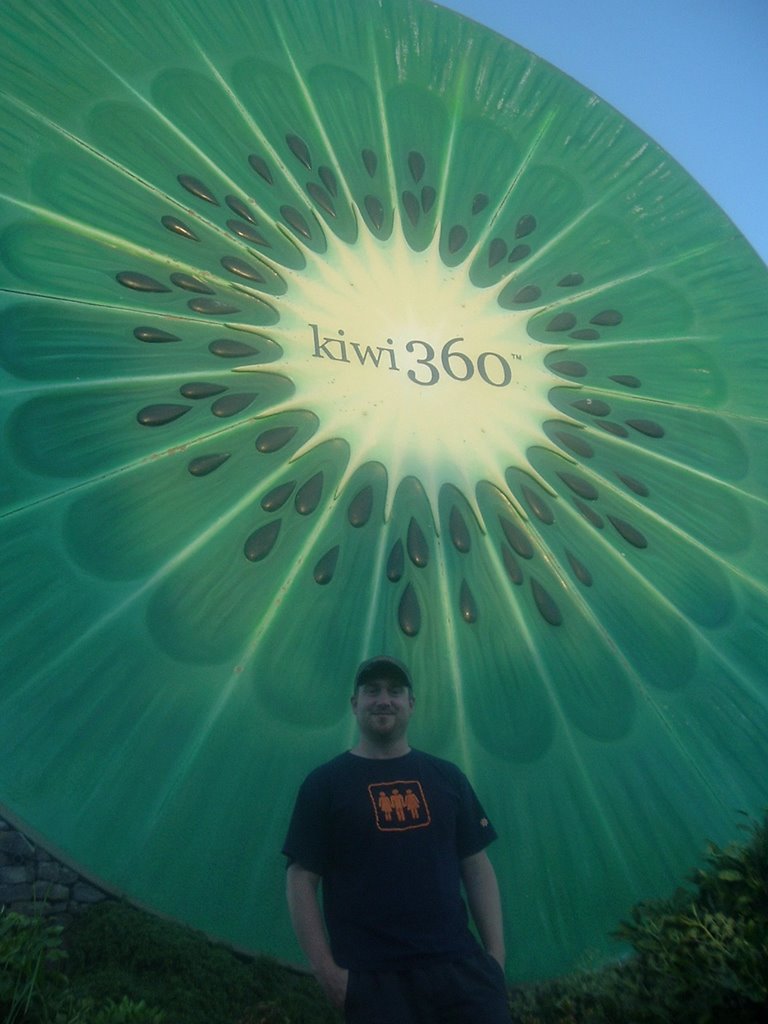
big kiwi

I'm a sucker for roadside tourist traps. This is, obviously, a big Kiwifruit. You can even walk up stairs inside and look out a small window (it's about four or five stories, and you look out on, well, nothing in particular).

Monday, May 15, 2006

when it's cold outside, I got the month of May

Wellington is once again living up to its reputation as a good city with bad weather. After a month of traveling around the North in generally good weather - warm and sunny more often than not - we have been getting a dose of winter here. Rain, wind and cold. Not the crisp cold of snow and ice, but the skin-chilling cold of air hovering just above the freezing point.
And for some reason, New Zealanders have decided they don't like easy methods of heating houses. Central heating is nearly unknown here. Even efforts to warm up with portable heaters are mostly useless - most people have radiant heaters without any fan to spread the air. This results mostly in warming the inch of so of air nearest the heater, and nothing else.

I asked a group of natives why they hate central heating, and got a vague answer involving macho posturing and suppressed masochism.
More fun was the response I got when I mentioned I hadn't seen a single dwelling with central heating, including our brand-new apartment building.
"There's central heating in Kelburn (a Wellington suburb)," one said.
"Parts of Thorndon," another added.
A few other areas of the city were mentioned, as were urban legend-type sightings: "My aunt's neighbor has central heating."
A comfortable indoor temperature, at least among the poor 20-something crowd in Wellington, inspires tales which sound like sailors swapping stories of mermaids a few hundred years back.
They didn't have central heating then, either, I suppose.